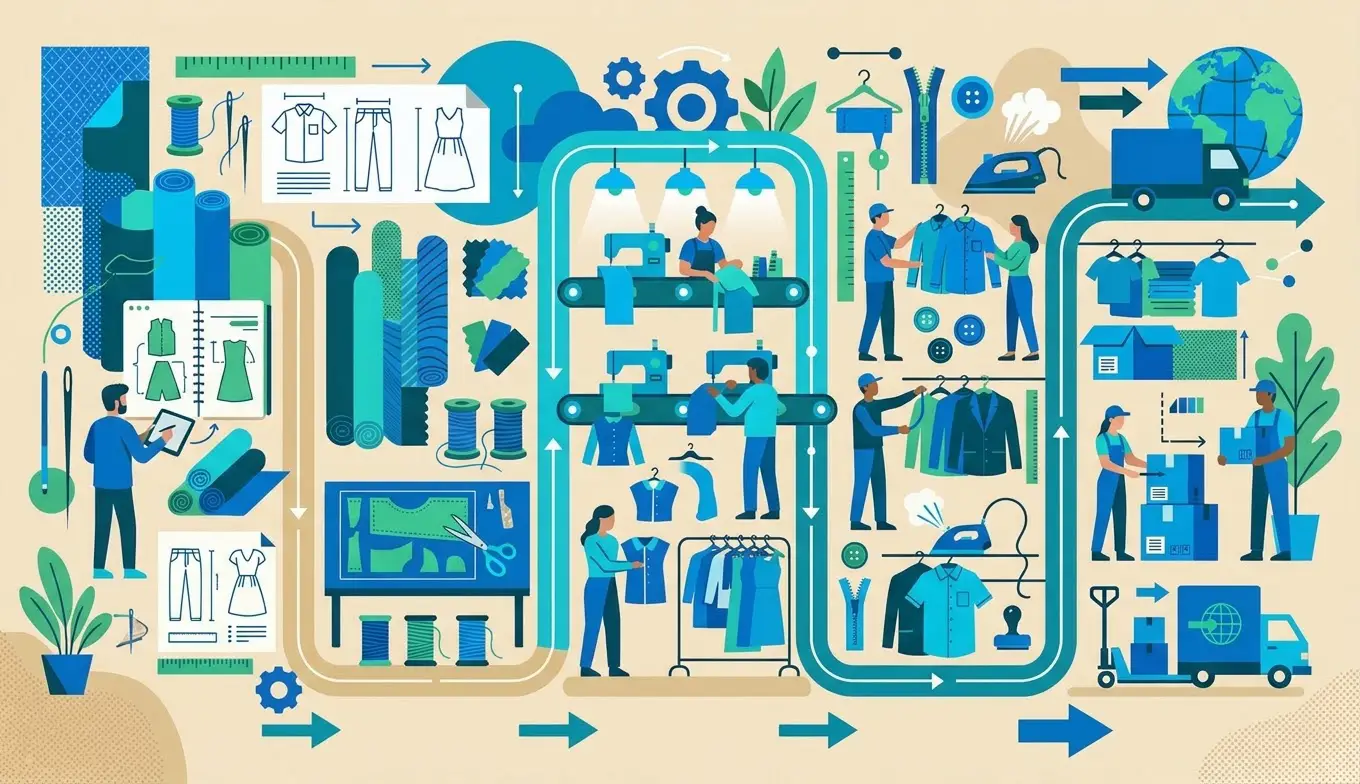
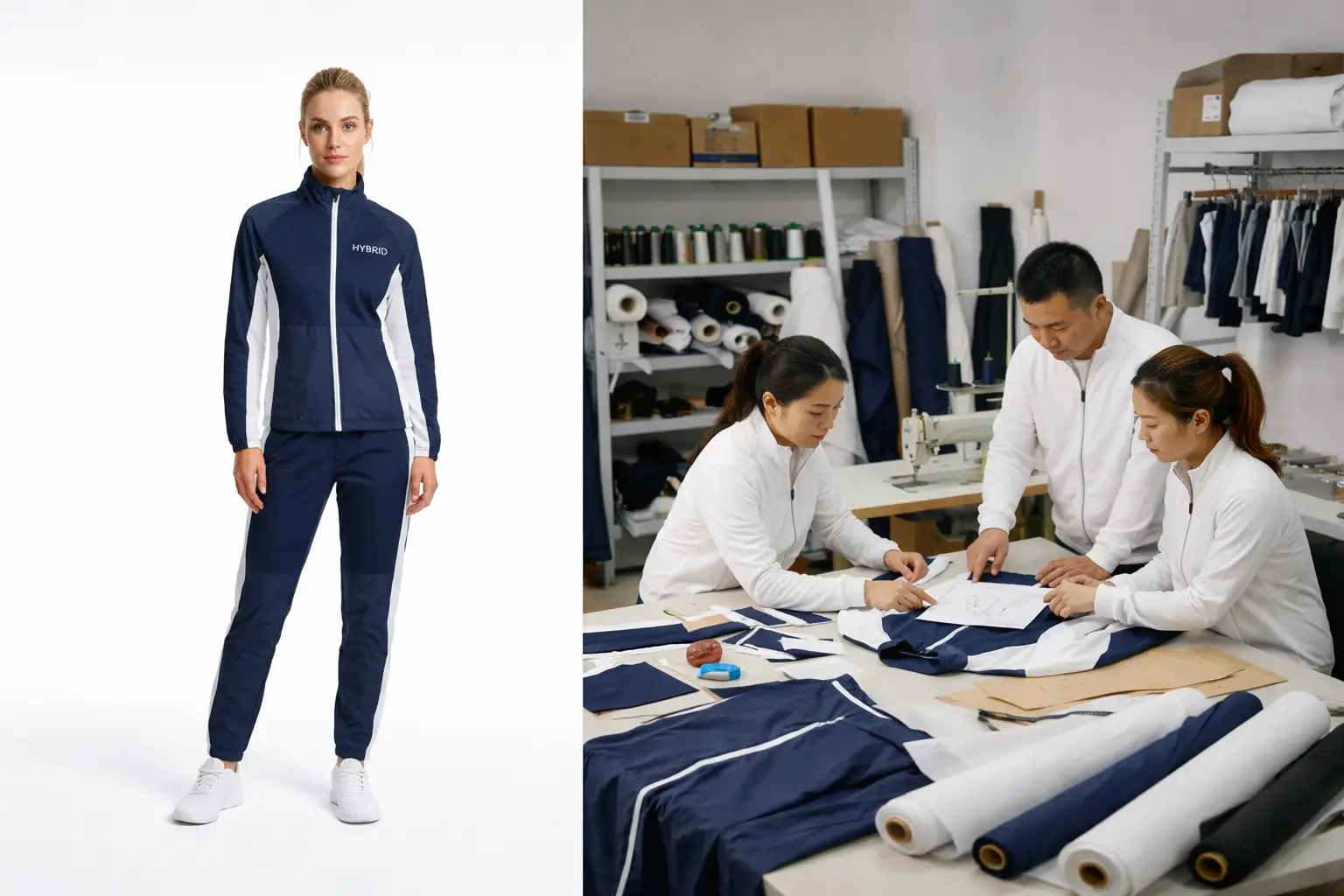
Chapter 1: Factory Overview — The Architecture Behind Our Manufacturing System
Understanding Our Monthly Capacity of 200,000 Pieces
When we state that our monthly capacity reaches 200,000 pieces, we are not merely presenting a numerical figure.
This number represents the culmination of years of strategic planning, infrastructure investment, and operational refinement.
Our production facility has been architected around a core philosophy that we call “Dedicated Lines with Flexible Allocation” — a system designed to deliver both the consistency of specialized production and the adaptability required by today’s dynamic apparel market.
The foundation of our manufacturing capability rests upon ten dedicated mass production lines, each strategically assigned to specific product categories based on their unique technical requirements.
This specialization is not arbitrary; it is the result of extensive data analysis spanning multiple production cycles, customer feedback, and continuous improvement initiatives.
We have discovered through years of operation that when production lines focus on specific garment types, the cumulative effect of operator familiarity, optimized equipment configuration, and streamlined material flow creates efficiency gains that far exceed what general-purpose lines can achieve through overtime or additional staffing.
Our Production Line Configuration
Sportswear Top Lines (4 Lines)
Four of our dedicated lines focus exclusively on sportswear tops — T-shirts, tank tops, sweatshirts, and similar upper body garments.
These lines are equipped with specialized machinery selected specifically for the demands of knitwear production.
Each line features automatic fabric spreading machines that ensure precise layer alignment, critical for maintaining consistency across hundreds of layers during the cutting process.
The four-needle six-thread sewing machines installed on these lines create flat, comfortable seams essential for athletic wear, while automatic overlock machines finish edges with the elasticity required for active movement.
The operators on these lines have developed an almost intuitive understanding of knit fabric behavior.
They understand how different fiber compositions — whether pure cotton, cotton-polyester blends, or high-performance synthetic materials — respond to varying needle types, thread tensions, and stitch densities.
This expertise translates into consistent quality across production runs, reduced defect rates, and the ability to identify potential issues before they become costly problems.
Functional Outerwear Lines (3 Lines)
Three production lines are dedicated to functional outerwear — jackets, windbreakers, softshell garments, and other complex pieces that require specialized construction techniques.
These lines represent our highest technical capability, equipped with seam sealing machines that apply waterproof tape to critical seams, laser cutting systems for precision pattern cutting on technical fabrics, and seamless bonding equipment for creating clean, waterproof joints without traditional stitching.
The operators on these lines undergo extensive training in handling technical fabrics — materials with waterproof membranes, breathable coatings, and specialized finishes that require careful temperature control and handling procedures.
They understand the critical parameters for seam sealing: the precise temperature range of 140-160 degrees Celsius, the pressure application of 3-5 kg/cm², and the dwell time of 8-12 seconds that ensures proper adhesion without damaging sensitive membrane materials.
Complex Craftsmanship Lines (3 Lines)
Our remaining three lines serve as our technical reserve, dedicated to orders requiring complex craftsmanship — garments with multiple print applications, intricate embroidery, complex panel construction, or specialized decorative techniques.
These lines feature digital printing systems capable of high-resolution graphic reproduction, computerized embroidery machines with multiple head configurations for efficient production of decorated garments, and template sewing systems that ensure precise, repeatable stitching patterns for complex designs.
These lines handle our most challenging orders, where multiple decorative techniques must be coordinated, where unusual material combinations require specialized handling, or where experimental designs push the boundaries of conventional manufacturing.
The operators here are our most experienced craftspeople, capable of troubleshooting unusual situations and developing custom solutions for unique design requirements.
Sample Development Infrastructure
Parallel to our mass production lines, we maintain twenty dedicated sample development lines operating as independent units.
This physical separation of sample production from mass manufacturing is a deliberate architectural choice, reflecting our understanding that these two activities have fundamentally different operational requirements.
Sample development demands flexibility, rapid iteration, and the ability to accommodate frequent changes.
A sample might go through three or four versions before final approval, with adjustments to fit, materials, or construction details between each iteration.
This process requires operators who can quickly adapt to changing requirements, who understand the experimental nature of sample work, and who can provide constructive feedback when design elements present manufacturing challenges.
Mass production, conversely, demands consistency, efficiency, and the elimination of variation.
Once a design is approved for production, the goal is to replicate that approved sample exactly, hundreds or thousands of times, with minimal deviation.
The mindset required for efficient mass production — focused on standardization and repeatability — can be disrupted by the iterative, experimental nature of sample development.
Our sample lines operate in small teams of two to three operators each, allowing for parallel development of multiple styles simultaneously.
This structure means that even when our mass production lines are operating at full capacity, new projects can enter sample development without delay.
We can handle thirty or more SKUs in concurrent sample development, ensuring that emerging brands can move quickly from concept to prototype without waiting for production capacity to become available.
Capacity Flexibility: The 95% Scalability Factor
The 95% capacity flexibility figure we quote is not a marketing claim but a measured operational capability.
It represents our system’s ability to maintain productive output across varying order structures, from small-batch multi-SKU programs to large-volume single-style runs.
Small-Batch Multi-SKU Scenarios
For orders characterized by small quantities per style but high style counts — perhaps one hundred to three hundred pieces across ten to twenty different designs — our system maintains approximately 85-90% of rated capacity.
This efficiency is achieved through intelligent production scheduling that groups orders with similar construction characteristics on the same production line, minimizing the changeover time between styles.
Our production planning system analyzes incoming orders for compatibility factors: similar fabric types that can use the same needle and thread configurations, comparable seam types that allow shared machine setups, or decorative techniques that can be applied in sequence without extensive reconfiguration.
By optimizing the production sequence, we reduce the non-productive time associated with line changeovers, maintaining throughput even with highly fragmented order structures.
Standard Order Scenarios
Our rated capacity of 200,000 pieces per month is calculated based on standard order characteristics: average quantities of 500-1,000 pieces per style-color combination, medium complexity construction involving two to three special processes, and the standard 25-day production cycle that includes material procurement, manufacturing, quality control, and packaging.
Under these standard conditions, our ten production lines operating on regular schedules can consistently deliver the rated output while maintaining our quality standards and delivery commitments.
Large-Volume Single-Style Scenarios
For large-volume orders — single styles exceeding 5,000 pieces — our capacity can actually exceed the rated 200,000 pieces, reaching 105-110% of standard capacity.
This apparent paradox is explained by the efficiency gains of continuous production: when a line can run the same style for extended periods, changeover time is eliminated, operator rhythm is optimized, and material flow becomes perfectly synchronized.
In these scenarios, the dedicated line assigned to the order operates with maximum efficiency, while our production planning team coordinates material delivery in precise synchronization with consumption rates, minimizing both stockholding costs and production interruptions.
Emergency Order Scenarios
For genuinely urgent requirements — perhaps a sudden market opportunity that demands product availability within two weeks — we can activate our “Fast Track” protocol.
This involves dedicating sample line capacity to rapid production, utilizing pre-approved materials from our safety stock, and coordinating overtime scheduling across multiple shifts.
Under Fast Track conditions, we can compress the standard production cycle to as little as 14 days, though this service requires advance coordination and may involve premium pricing to cover the additional resources deployed.
Delivery Performance: The 97.5% On-Time Rate
Our 97.5% on-time delivery rate is the result of a three-tier commitment system that begins the moment an order is confirmed and continues until the finished goods are dispatched.
Tier One: Advance Capacity Locking
When you confirm an order with us, that commitment immediately triggers a capacity reservation in our production planning system.
The specific production line and time slot for your order are locked, preventing other orders from being scheduled in conflict with your delivery requirements. This locking occurs regardless of whether material procurement has begun, ensuring that production capacity is preserved for your order.
Tier Two: Weekly Progress Monitoring
Every Monday, our production planning system generates comprehensive progress reports for all active orders.
These reports capture the current status of each order — whether materials have been received, whether cutting is complete, whether sewing is in progress, and so forth — and compare actual progress against the planned timeline.
Any order showing deviation from the planned schedule triggers an alert to the assigned project manager, who must investigate the cause and develop corrective action.
This weekly rhythm ensures that potential delays are identified while there is still time to implement recovery measures — typically with a seven-day advance warning before any impact on the final delivery date.
Tier Three: Contingency Protocols
Despite our best planning, unforeseen circumstances can arise — a supplier delay, an equipment malfunction, or an unexpected quality issue. For these situations, we maintain contingency protocols at critical decision points throughout the production process.
Our material safety stock provides a buffer against supplier delays for core fabric categories.
Our equipment maintenance program minimizes the risk of unexpected breakdowns, but when they occur, we have backup equipment or can quickly source replacements.
Our quality control system catches issues early, when correction is still feasible without major schedule impact. And our network of partner facilities provides surge capacity when our internal resources are insufficient.
Minimum Order Quantity: 100 Pieces
Our minimum order quantity of 100 pieces per color reflects a careful balance between production efficiency and market accessibility.
At this quantity, the setup costs associated with pattern preparation, machine configuration, and quality standardization can be distributed across enough units to maintain reasonable unit economics, while still being accessible to emerging brands testing new designs or entering new markets.
We recognize that some startups may wish to order even smaller quantities for initial market testing. For these situations, we can accommodate orders as small as 50 pieces, though the per-unit cost will be higher due to the fixed costs being spread across fewer units.
We view these small initial orders as investments in future relationships — when brands validate their market and scale up, we want to be their established manufacturing partner.
Chapter 2: Supply Chain Integration — Four Layers of Protection
Understanding Supply Chain Risk in Apparel Manufacturing
The most significant risks in apparel manufacturing often originate not within the factory walls, but somewhere upstream in the supply chain. A delayed fabric shipment can idle an entire production line.
A quality issue with a zipper batch can require hundreds of completed garments to be reworked. A supplier’s financial difficulty can leave you scrambling to find alternative sources mid-season.
We have constructed our supply chain management system around four protective layers, each designed to identify, mitigate, or respond to these risks. This system has been developed over years of operation, refined through real-world challenges, and continuously improved based on lessons learned.
Layer One: Stable Raw Material Supply Network
The foundation of our supply chain protection is a network of core material suppliers with whom we maintain annual framework agreements.
These agreements are not simple purchase contracts; they are strategic partnerships that include capacity reservations, quality protocols, and collaborative development initiatives.
Basic Knit Fabrics
For basic knit fabrics — cotton, cotton-polyester blends, and standard polyester materials — we maintain a 90-day safety stock.
This inventory buffer means that even if a supplier experiences unexpected production issues, we have sufficient material on hand to continue operations while the issue is resolved or alternative sources are activated.
The safety stock is managed dynamically, with consumption rates monitored continuously and replenishment orders triggered automatically when inventory falls below predetermined thresholds.
This system ensures that we rarely face material shortages for these core categories, which represent the majority of our production volume.
Functional Fabrics
For functional fabrics — moisture-wicking materials, antimicrobial treatments, UPF sun protection fabrics, and similar performance textiles — we maintain collaborative development relationships with specialized suppliers.
These partnerships go beyond simple procurement; they involve joint testing of new technologies, shared development of custom formulations, and mutual investment in quality improvement.
Because functional fabrics often involve proprietary technologies or specialized manufacturing processes, supplier relationships in this category are particularly important.
Our partner suppliers understand our quality standards, our testing protocols, and our delivery requirements, which streamlines the procurement process and reduces the risk of miscommunication.
Specialty Materials
For specialty materials — wool, silk, recycled fibers, and other non-standard inputs — we lock in quarterly capacity commitments well in advance of the production season. These materials typically have longer lead times, limited supplier options, and higher price volatility, making advance planning essential.
By committing to specific volumes in advance, we secure both material availability and price stability, protecting against the market fluctuations that can affect these specialized categories.
Supplier Qualification Standards
Every supplier in our core network has passed a rigorous qualification process that examines multiple dimensions of their capability:
Certification Requirements
We require our suppliers to maintain current certifications relevant to their product categories.
For fabric suppliers, this typically includes ISO 9001 quality management certification, demonstrating systematic quality control processes. For materials intended for consumer products, OEKO-TEX Standard 100 certification ensures that the materials are free from harmful substances.
For recycled or sustainable materials, GRS (Global Recycled Standard) certification verifies the recycled content claims.
These certifications are not merely checked at onboarding; we monitor their renewal status and conduct periodic audits to ensure ongoing compliance.
Capacity Assessment
Before a supplier enters our core network, we conduct on-site assessments of their production capacity, equipment condition, and quality control systems.
We review their monthly production volumes, verify that their equipment is properly maintained, and examine their quality testing capabilities.
This assessment is not a one-time event; we revisit our key suppliers annually to confirm that their capabilities continue to meet our requirements and to identify any changes that might affect our sourcing decisions.
Performance History
We require a minimum of twelve months of trading history and at least three successful bulk delivery cycles before a supplier can be considered for our core network.
This requirement ensures that we have sufficient data to evaluate their delivery reliability, quality consistency, and responsiveness to issues.
Suppliers who fail to meet our performance standards during this qualification period are not admitted to the core network, regardless of their certifications or capacity.
Conversely, suppliers who consistently exceed expectations may be elevated to preferred status, with increased order volumes and collaborative development opportunities.
Layer Two: Multi-Supplier Parallel Management
Even with qualified core suppliers, we never rely on a single source for any critical material.
Every key material category has at least two, and often three, qualified suppliers in our network, configured in a “primary plus backup” arrangement.
The 70-15-15 Distribution Model
Our typical supplier allocation follows a 70-15-15 distribution: the primary supplier handles approximately 70% of our volume for a given material, while two backup suppliers each handle approximately 15%.
This distribution is carefully calibrated to achieve multiple objectives.
The primary supplier’s 70% share is sufficient to make the relationship economically significant, ensuring that we receive priority treatment and favorable pricing.
The volume is also large enough to justify investment in relationship development, joint improvement initiatives, and collaborative problem-solving.
The backup suppliers’ 15% shares serve multiple purposes.
First, they ensure that the backup suppliers remain operationally active with our materials, maintaining their familiarity with our specifications and quality requirements. A supplier who has not processed our orders for six months may require retraining or requalification when suddenly called upon; the 15% ongoing volume prevents this skill decay.
Second, the 15% shares provide a realistic test of the backup suppliers’ capabilities. We receive regular performance data on delivery times, quality metrics, and responsiveness, allowing us to confirm that backup suppliers can perform when needed.
Third, the 15% shares create switching capability.
If we need to shift volume from the primary supplier due to quality issues, capacity constraints, or other problems, the backup suppliers are already familiar with our requirements and can absorb additional volume without extensive onboarding.
The 48-Hour Switching Protocol
When we need to switch from a primary supplier to a backup — whether due to quality failures, delivery delays, or other issues — our target switching time is 48 hours. This rapid response is possible because of the preparation work done through the ongoing 15% allocation.
Backup suppliers already have our material specifications on file. Their quality control systems are already calibrated to our standards.
Their production schedulers already understand our delivery requirements.
When a switch is triggered, we simply increase the order volume to the backup supplier, who can typically accommodate the increase within their existing capacity or through modest overtime scheduling.
The materials from backup suppliers have already been pre-qualified through the ongoing small-volume orders, so we do not need to conduct extensive incoming inspection when volumes increase. We can move directly to production, minimizing the delay associated with the supplier switch.
Layer Three: Collaborative Manufacturing Resource Network
Beyond our internal production capacity, we have developed a network of approximately twenty specialized partner facilities in our region.
These partners are not subcontractors in the traditional sense; they are an extension of our production capability, operating under our quality standards and integrated into our planning systems.
Network Capabilities
Our partner network provides specialized capabilities that complement our internal lines:
Specialized Printing
Screen printing, digital printing, heat transfer, and discharge printing each require different equipment, different skill sets, and different environmental controls.
Rather than maintaining all these capabilities internally — which would require significant capital investment and specialized expertise — we partner with facilities that focus exclusively on specific printing technologies.
These partners have invested in the latest printing equipment, maintain specialized technical staff, and have developed deep expertise in their specific domains. When your designs require printing applications, we coordinate with the appropriate partner to ensure optimal results.
Professional Embroidery
Embroidery encompasses multiple techniques — flat embroidery, 3D embroidery, appliqué, chenille — each requiring specific machine configurations and operator skills.
Our embroidery partners maintain diverse machine parks capable of handling complex multi-color designs, large-scale applications, and specialized effects.
Finishing Services
Garment finishing — washing, enzyme treatments, coating applications, and similar processes — often requires specialized equipment and environmental controls that would be inefficient for us to maintain for occasional use.
Our finishing partners provide these services on demand, with capabilities ranging from standard garment washing to specialized treatments that create unique fabric handfeels or appearances.
Trim Manufacturing
Woven labels, printed labels, hangtags, and packaging materials are often customized for each brand and each collection. Rather than maintaining in-house trim production, we work with specialized trim manufacturers who can quickly produce small-batch custom items, accommodate design changes, and maintain consistent quality across repeat orders.
Surge Capacity Function
Beyond their specialized capabilities, our partner network provides surge capacity during peak demand periods.
When our internal lines are fully committed and additional orders arrive, we can offload specific operations to partner facilities, effectively expanding our production capacity by 30-40% without the fixed costs of maintaining idle capacity during slower periods.
This surge capacity is coordinated through our production planning system, which tracks capacity utilization across both internal lines and partner facilities, allowing us to optimize the allocation of work based on capability match, current workload, and delivery requirements.
Layer Four: Transparent Material and Production Traceability
From the moment materials enter our facility until finished goods are dispatched, every batch is tracked through a comprehensive traceability system. This system serves multiple purposes: quality control, regulatory compliance, customer transparency, and continuous improvement.
The Traceability Code
Every material batch receives a unique traceability code at receipt. This code follows the material through every stage of production, accumulating data about its journey through our facility.
The traceability record includes:
Material Origin Information
The batch number assigned by the supplier, the supplier’s identification, the date of receipt, and the results of incoming quality inspection. This information allows us to trace any quality issues back to their source and to manage supplier performance over time.
Production Process Data
The specific production line where the material was processed, the operators who handled it, the equipment used, and the process parameters applied.
This granular tracking enables us to identify process variations that might affect quality and to optimize our operations based on data analysis.
Quality Records
All inspection results, including any defects identified, rework performed, and final acceptance decisions.
This quality history provides the basis for our continuous improvement efforts and for customer reporting on quality performance.
Packaging and Dispatch Information
The packaging configuration, carton markings, dispatch date, and logistics tracking information. This data completes the traceability chain, allowing us to track finished goods all the way to delivery.
Customer Transparency
Our traceability system includes customer-facing capabilities that allow you to monitor your orders in real time.
Through our customer portal, you can view the current status of each order, see photographs from key production stages, and access the complete production history once the order is complete.
This transparency is not merely a service feature; it is an expression of our confidence in our processes and our commitment to accountability.
We believe that customers who can see their production in progress develop greater trust in our partnership and can provide more informed feedback when they have visibility into the manufacturing process.
Chapter 3: Engineering Capability — From Design to Manufacturable Product
The Challenge of Design Translation
One of the most common sources of friction in apparel manufacturing arises from the gap between design intent and manufacturing reality. A designer creates a sketch or a digital rendering that captures a vision.
A pattern maker translates that vision into a physical sample. But when that sample moves to mass production, unexpected challenges emerge — a construction detail that cannot be replicated at scale, a material interaction that creates quality issues, or a process requirement that drives costs beyond the target.
Our engineering team exists to bridge this gap, working from the earliest stages of product development to ensure that design concepts are translated into manufacturable products without losing the essence of the original vision. This process — which we call Design for Manufacturability, or DFM — is not about constraining creativity; it is about channeling creativity in directions that can be successfully executed.
Design for Manufacturability Optimization
When you submit a design concept to us, our engineering review examines three dimensions of manufacturability: structural feasibility, process compatibility, and cost achievability.
Structural Feasibility Analysis
The first level of DFM analysis examines the garment’s construction details for manufacturing compatibility:
Seam Allowance Evaluation
Standard seam allowances in apparel manufacturing range from 1 to 1.5 centimeters, with complex areas sometimes requiring up to 2 centimeters.
When designs specify seam allowances outside these ranges — either too narrow, which risks seam failure, or unnecessarily wide, which wastes material and creates bulk — our engineers identify these issues and recommend adjustments.
Seam Angle Assessment
Sewing machines have physical limitations regarding the angles at which they can effectively join fabric pieces.
Seam angles below approximately 30 degrees create significant manufacturing challenges, as the machine foot cannot properly guide the material, resulting in inconsistent stitch quality.
Our engineers review pattern pieces for problematic angles and suggest modifications where necessary.
Construction Optimization
Complex garments sometimes include redundant construction elements — multiple seams that could be combined, internal structures that add cost without functional benefit, or decorative elements that create manufacturing bottlenecks.
Our engineers analyze the construction sequence to identify optimization opportunities that maintain the design intent while simplifying production.
Process Compatibility Assessment
Beyond basic construction, our DFM review examines the compatibility of specified processes with manufacturing capabilities:
Print Application Analysis
Print designs are evaluated against the capabilities of available printing technologies. We assess whether the design’s size, color count, and detail level are appropriate for the specified printing method — whether screen printing, digital printing, heat transfer, or another technique.
We identify potential issues such as registration challenges on curved surfaces, color bleeding risks on certain substrates, or durability concerns with specific ink formulations.
Embroidery Feasibility
Embroidery designs are analyzed for compatibility with available equipment and for interaction with the specified base materials. High-density embroidery on lightweight fabrics can cause puckering or distortion.
Complex multi-color designs may require impractical numbers of thread changes. Our engineers identify these issues and recommend adjustments to stitch density, design simplification, or material selection.
Special Process Parameters
For special processes such as seam sealing, bonding, or coating, we verify that the specified parameters — temperature, pressure, dwell time — fall within the operational ranges of our equipment and are appropriate for the specified materials.
Processes that require conditions outside standard ranges may need specialized equipment or may be infeasible for volume production.
Cost Achievability Evaluation
The final dimension of DFM analysis examines whether the design can be produced within target cost parameters:
Material Cost Analysis
We calculate the material consumption for the specified design, accounting for pattern efficiency, seam allowances, and waste factors.
If material costs exceed targets, we may suggest pattern optimization, alternative material specifications, or construction modifications that reduce material requirements.
Labor Cost Assessment
Each construction operation is evaluated for labor content, based on standard time studies and our historical production data.
Complex operations or unusual construction sequences may require significantly more labor time than standard garments. We identify these cost drivers and suggest alternatives where possible.
Process Cost Evaluation
Special processes — printing, embroidery, washing, finishing — each carry associated costs for equipment setup, material consumption, and processing time.
We evaluate the cumulative cost of all specified processes and identify opportunities for cost reduction through process consolidation, efficiency improvements, or specification adjustments.
Precise Material and Process Matching
Different materials respond differently to manufacturing processes. A stitch setting that produces perfect results on cotton jersey may create puckering on lightweight synthetic, or may be insufficient for heavy fleece.
Our engineering team maintains a comprehensive material-process database that guides the selection of optimal parameters for each material type.
Material Characterization
For each material we work with, our database includes:
Physical Properties
Fiber composition, fabric weight (grams per square meter), stretch characteristics (both two-way and four-way stretch), and fabric thickness.
These properties determine fundamental processing parameters such as needle selection, thread type, and machine tension settings.
Performance Characteristics
Colorfastness ratings (to washing, light, and rubbing), shrinkage percentages, and strength properties.
These characteristics affect both the manufacturing process — pre-shrinking requirements, handling precautions — and the end-use performance of the finished garment.
Process Compatibility
Temperature sensitivity for heat-related processes, chemical compatibility for washing and finishing treatments, and adhesion properties for bonding applications. This data ensures that specified processes will not damage the material or compromise its performance.
Process Parameter Optimization
Based on material characterization, our engineers specify optimal process parameters for each production operation.
These specifications are not generic recommendations; they are calibrated to our specific equipment and validated through production trials.
For example, sewing parameters for a specific material might include:
Needle type and size (e.g., ballpoint needle, size 90/14)
Thread type and weight (e.g., polyester core-spun, Tex 40)
Stitch type and density (e.g., lockstitch, 12 stitches per inch)
Machine tension settings (upper and lower thread tensions)
Presser foot pressure
Feed dog settings
These parameters are documented in the production specification for each style and are verified during the sample approval process.
Standardized Sample-to-Bulk Production Conversion
The transition from sample production to mass manufacturing is a critical risk point in apparel development. Samples are often produced with extra care, by the most skilled operators, with additional time for attention to detail. Mass production must replicate the sample quality at scale, with standard operators, within cycle time constraints, and at target cost.
Our approach to this transition emphasizes standardization and verification at each step.
Sample Documentation
Every approved sample is accompanied by a comprehensive production specification that documents:
Construction Details
Complete sewing instructions, including seam types, stitch specifications, seam allowances, and construction sequence.
These instructions are developed in collaboration with the sample production team, capturing the techniques that achieved the approved result.
Material Specifications
Exact material identification, including supplier, product code, color reference, and any special handling requirements. This precision ensures that mass production uses identical materials to the approved sample.
Process Specifications
All special processes — printing, embroidery, washing, finishing — documented with exact parameters, artwork references, and quality standards. These specifications become the production standard for bulk manufacturing.
Measurement Specifications
Complete size chart with measurement points, measurement methods, and tolerance ranges. These specifications ensure that bulk production achieves the same fit as the approved sample.
First Article Inspection
Before bulk production begins, we produce a “first article” — the first production unit manufactured using the bulk production setup.
This first article is compared in detail to the approved sample, verifying that:
Construction details match the sample exactly
Measurements fall within specified tolerances
Visual appearance matches the sample (color, texture, finish)
Special processes achieve the specified results
Overall quality meets the approval standard
Any discrepancies identified during first article inspection are corrected before bulk production proceeds.
This verification step prevents the cost and delay of discovering issues after hundreds or thousands of units have been produced.
Pre-Production Meeting
Before bulk production launch, we conduct a pre-production meeting involving all stakeholders: the project manager, production supervisors, quality control staff, and key operators.
This meeting reviews the production specification, discusses any special requirements or potential challenges, and confirms that everyone understands the quality standards and production targets.
This alignment meeting ensures that the entire production team is working toward the same standard, reducing the risk of misinterpretation or inconsistent execution.
Batch Consistency Control
Once bulk production is underway, maintaining consistency across the production run is essential.
Our batch consistency control system monitors key parameters throughout production to identify and correct variations before they affect significant quantities.
Cutting Stage Controls
Layer Count Management
The number of fabric layers in a cutting spread affects cutting accuracy. Too many layers result in shifting and inaccurate cutting in the lower layers; too few layers reduce cutting efficiency.
We specify maximum layer counts based on fabric characteristics — typically 50 layers for lightweight fabrics, 30 layers for heavier materials.
Pattern Alignment Verification
For fabrics with stripes, checks, or directional patterns, we verify that pattern pieces are aligned correctly to achieve the specified matching at seams.
Critical match points — center fronts, pocket placements, side seams — are checked for alignment accuracy, with tolerances typically not exceeding 2 millimeters.
Cutting Accuracy Inspection
Cut pieces are inspected for accuracy against the pattern templates, verifying that curves are smooth, corners are precise, and overall dimensions are correct.
Any cutting errors are identified before pieces move to sewing, preventing the waste of sewing time on defective components.
Sewing Stage Controls
Stitch Quality Monitoring
Stitch quality is monitored continuously during production, checking for consistent stitch formation, proper tension, and absence of defects such as skipped stitches or thread breaks.
Operators are trained to recognize and correct stitch quality issues immediately.
Seam Specification Verification
Critical seams are periodically measured and inspected to verify that seam allowances, stitch densities, and seam types match the production specification.
Any deviations trigger immediate investigation and correction.
Construction Sequence Compliance
The construction sequence specified in the production documentation is designed to achieve optimal efficiency and quality.
Deviations from the specified sequence can result in access difficulties, quality compromises, or increased labor time.
Production supervisors monitor sequence compliance and address any unauthorized variations.
Finishing Stage Controls
Pressing Parameter Verification
Pressing — the application of heat and pressure to set seams and shape the garment — requires precise parameter control. Temperature is set according to fabric fiber content (typically 160-180°C for cotton, 120-140°C for polyester), pressure is adjusted for fabric thickness, and dwell time is optimized for the desired effect.
These parameters are verified at the start of each production batch and monitored throughout.
Trim and Thread Control
Excess thread and loose threads are removed according to specified standards — typically, thread ends should not exceed 3 millimeters.
This attention to detail affects both the garment’s appearance and its perceived quality.
Final Measurement Verification
Finished garments are measured at specified points to verify that they meet the size chart tolerances.
Measurements that fall outside tolerance ranges trigger investigation into the cause — whether pattern issues, sewing variations, or material behavior — and corrective action.
Advanced Craftsmanship Implementation
Beyond standard production processes, we have developed capabilities in advanced craftsmanship techniques that enable us to execute complex or unusual design requirements.
Seam Sealing Technology
For waterproof and water-resistant garments, seam sealing — the application of waterproof tape over stitched seams — is critical to performance.
Our seam sealing equipment can handle various tape widths and types, with precise temperature, pressure, and speed control to ensure proper adhesion without damaging sensitive membrane materials.
Our operators are trained in the visual inspection of sealed seams, identifying defects such as incomplete adhesion, air bubbles, or tape misalignment that could compromise waterproof performance.
Seamless Bonding
Seamless bonding — joining fabric pieces using adhesive rather than stitching — creates clean, flat seams ideal for next-to-skin applications or minimalist aesthetic designs.
Our bonding equipment handles various adhesive types and fabric combinations, with process parameters optimized for each specific application.
Laser Cutting and Engraving
Laser technology enables precise cutting of complex shapes and detailed engraving or perforation effects.
Our laser systems can handle both cutting operations — for pattern pieces or decorative elements — and surface treatments — for creating textured effects or ventilation perforations.
Specialized Embroidery Techniques
Beyond standard flat embroidery, we offer various specialized techniques including 3D embroidery (creating raised, dimensional effects), appliqué (applying fabric pieces with embroidery edging), chenille (creating a velvet-like texture), and sequin or bead embellishment.
Rapid Technical Issue Resolution
Despite all preventive measures, technical issues can arise during production. When they do, our response protocol is designed to minimize impact and prevent recurrence.
Issue Identification and Escalation
Production operators are trained to identify potential technical issues — unusual fabric behavior, equipment malfunctions, quality deviations — and to escalate them immediately to supervisory staff. Early identification is critical; issues caught after a few units can be corrected before they affect the entire production run.
Engineering Response
When a technical issue is escalated, our engineering team responds within two hours.
The engineer assesses the situation, identifies the root cause, and develops a corrective action plan. This plan might involve process parameter adjustments, equipment repairs, material substitutions, or construction modifications.
Solution Validation
Proposed solutions are validated before full implementation.
For process changes, we produce test units to confirm that the modification achieves the desired result without introducing new issues.
For equipment repairs, we verify that the equipment is functioning correctly before returning it to production.
Implementation and Monitoring
Once validated, the solution is implemented across affected production. Quality control monitoring is intensified during the transition period to confirm that the issue is resolved and that no new issues have been introduced.
Prevention Documentation
After resolution, the issue and its solution are documented in our knowledge base. If the issue is of a type that could recur, preventive measures are implemented — perhaps a process modification, an additional inspection point, or operator training on recognizing early warning signs.
This continuous learning approach reduces the likelihood of similar issues in future production.
Part II: Brand Development Support
Chapter 4: Building Your Brand from Idea to Market
The Journey from Concept to Commercial Product
For emerging brands, the path from a design concept to a product on the market is filled with challenges that extend far beyond manufacturing.
Understanding your target customer, refining your design vision, selecting appropriate materials, developing production-ready specifications, validating through sampling, and finally executing bulk production — each stage requires specific expertise and careful management.
We provide comprehensive end-to-end development support designed to guide emerging brands through this journey efficiently and effectively.
Our goal is not merely to manufacture your products, but to serve as a strategic partner in your brand’s development, helping you bring products to market faster, with higher quality, and with greater confidence.
Stage One: Concept Clarification (Weeks 1-2)
The first stage of our engagement focuses on developing a deep understanding of your brand and your product vision.
This is not a cursory review; it is a structured discovery process designed to align our understanding with your intentions.
Brand Positioning Analysis
We begin by exploring your brand’s positioning in the market. Who is your target customer? What is their lifestyle, their preferences, their purchasing behavior?
What price point are you targeting, and what quality level does that price point imply?
What is your brand’s unique value proposition — what makes you different from existing options in the market?
This analysis helps us understand the context in which your products will exist. A brand targeting performance athletes has different requirements than one targeting fashion-conscious consumers or outdoor enthusiasts.
Understanding these differences allows us to provide relevant recommendations throughout the development process.
Competitive Landscape Review
We review your competitive landscape to identify opportunities for differentiation. What are existing brands offering?
Where are the gaps or underserved segments? What design elements, material choices, or construction techniques might set your products apart?
This competitive analysis is not about copying what others are doing; it is about understanding the market context so that your differentiation is meaningful and sustainable.
Initial Manufacturability Assessment
Even at this early stage, we conduct a preliminary manufacturability assessment of your design concepts.
Some design elements that look appealing in sketches may present significant manufacturing challenges — unusual material combinations, complex construction details, or specialized processes that add cost without proportional value. Identifying these issues early allows for design adjustments before significant development investment has been made.
The output of this stage is a Concept Alignment Document — a shared understanding of what you are building, for whom, and how it fits into the market landscape.
This document becomes the reference point for all subsequent development decisions.
Stage Two: Design Development (Weeks 3-4)
With a clear understanding of your brand and product vision, we move into the design development phase, where concepts begin to take concrete form.
Material Direction Recommendations
Based on your brand positioning, design aesthetic, functional requirements, and target price point, we recommend material directions for your consideration.
These recommendations include specific fabric types, weight ranges, fiber compositions, and finish options that align with your vision.
For each recommendation, we explain the rationale — why this material supports your design intent, what performance characteristics it offers, what cost implications it carries, and what availability or lead time considerations apply.
This transparency allows you to make informed material selections.
Silhouette and Fit Guidance
We provide guidance on silhouette and fit based on your target customer and design aesthetic.
Should the fit be slim and body-conscious, relaxed and comfortable, or structured and tailored?
How should the garment drape and move? What is the intended wearing occasion, and how does that influence fit decisions?
This guidance is informed by our experience with similar products and by current market trends, but ultimately the decisions are yours — our role is to provide the information you need to make confident choices.
Process and Decoration Planning
If your designs include decorative elements — printing, embroidery, appliqué, or special finishes — we develop preliminary process plans.
What decoration techniques are appropriate for your design and material choices?
What are the cost and lead time implications of different options? How will decoration elements be positioned and scaled?
This planning ensures that decoration decisions are integrated into the overall development process, not treated as afterthoughts that create complications later.
Cost Modeling
Throughout the design development phase, we maintain running cost models based on current assumptions.
These models help you understand the cost implications of design decisions as they are made, allowing you to balance design intent with commercial reality.
If a particular material or process pushes costs beyond your target, we can explore alternatives before the design is finalized.
Stage Three: Sample Development (Weeks 5-6)
Sample development is where the abstract becomes concrete — where design concepts are translated into physical garments that can be evaluated, tested, and refined.
Prototype Sample
The first sample we produce is the Prototype, focused on validating the basic construction and fit.
This sample may not use the final materials or include all decorative elements; its purpose is to confirm that the pattern achieves the intended silhouette and that the construction approach is sound.
We review the Prototype with you, discussing what works and what needs adjustment. Is the fit as intended?
Does the silhouette match the design vision? Are there any construction issues that need to be addressed?
Fit Sample
Based on Prototype feedback, we produce the Fit Sample, incorporating fit adjustments and using materials closer to the final selection. This sample is evaluated for fit accuracy, wearing comfort, and movement characteristics. If possible, we recommend fitting sessions with fit models representing your target customer body type.
The Fit Sample cycle may iterate multiple times until the fit is confirmed. Each iteration refines the pattern, moving closer to the final production standard.
Pre-Production Sample
Once fit is confirmed, we produce the Pre-Production Sample, using the exact materials and processes specified for bulk production. This sample represents the production standard — what bulk production should achieve.
It includes all decorative elements, finished trims, and packaging components.
The Pre-Production Sample undergoes comprehensive evaluation: visual inspection for appearance and finish, measurement verification against the size chart, functional testing for performance characteristics, and wear testing if appropriate.
Any issues identified are corrected before bulk production approval.
Sample Documentation
Each sample is accompanied by documentation capturing the decisions made and issues identified.
This documentation becomes part of the production specification, ensuring that the learning from sample development is carried forward into bulk production.
Stage Four: Bulk Production (Weeks 7-10)
With samples approved, we transition into bulk production, executing the manufacturing plan developed through the previous stages.
Material Procurement and Inspection
Bulk materials are procured according to the specifications confirmed during sample development.
Upon receipt, all materials undergo incoming quality inspection to verify that they meet the approved standard. Fabric is checked for color accuracy, weight, handfeel, and any visible defects.
Trims are verified for dimensions, color, and functionality.
Materials that fail incoming inspection are quarantined and the supplier is notified.
Depending on the nature of the issue, we may request replacement material, negotiate acceptable quality levels, or — in consultation with you — approve the material with documented concessions.
Production Execution
Bulk production follows the manufacturing plan developed during sample development, with the process parameters, quality checkpoints, and production schedule all defined in advance.
Our production management system tracks progress in real time, alerting supervisors to any deviations from plan.
Throughout production, quality control inspectors monitor output against the approved sample and production specification. Issues identified are addressed immediately, preventing the production of large quantities of defective goods.
Progress Reporting
We provide weekly progress reports throughout bulk production, keeping you informed of current status, completed milestones, and any issues or concerns. These reports include photographs from the production floor, allowing you to see your products being manufactured.
Final Inspection and Packaging
Completed garments undergo final inspection before packaging.
This inspection verifies that all quality requirements have been met, that measurements are within tolerance, and that the finished appearance matches the approved standard.
Approved garments are packaged according to your specifications — perhaps individual polybags, size-sorted cartons, or retail-ready packaging. Packaging includes all required labeling: brand labels, care labels, size labels, hangtags, and any regulatory labeling required for your target markets.
Logistics and Delivery
Packaged goods are dispatched according to your delivery requirements, with all necessary documentation: commercial invoices, packing lists, certificates of origin, and any specialized documentation required for customs clearance or regulatory compliance.
We coordinate with your freight forwarder or can recommend logistics partners with experience in apparel shipping. Tracking information is provided so you can monitor your shipment’s progress.
Design Fidelity and Brand Identity Protection
Throughout the development and production process, we maintain strict fidelity to your design intent. Our commitment is to execute your vision, not to modify it based on our convenience.
Tech Pack Adherence
We follow your Tech Pack specifications precisely, executing construction details, material selections, and process applications exactly as specified.
If we identify issues or opportunities for improvement, we raise them for discussion rather than making unilateral changes.
Brand Element Accuracy
Brand elements — logos, labels, packaging — are reproduced with careful attention to accuracy.
Colors are matched to your brand standards, dimensions are verified against your specifications, and placement is controlled using templates or positioning guides to ensure consistency.
Special Process Preservation
If your design includes special processes or unique craftsmanship elements that define your brand identity, we take particular care to preserve these characteristics.
Our engineering team works to ensure that these elements can be replicated consistently in bulk production, maintaining the distinctive qualities that set your brand apart.
Chapter 5: Scalable Production — Growing With Your Brand
The Evolution of Manufacturing Requirements
As brands grow, their manufacturing requirements evolve in predictable patterns. A startup brand might begin with small test orders — perhaps a few hundred pieces across several styles — to validate market response.
As products gain traction, order volumes increase, style counts expand, and the complexity of managing production grows accordingly.
Our manufacturing system is designed to accommodate this growth trajectory, providing consistent support from initial test orders through to large-scale production programs.
We understand that brands need a manufacturing partner who can scale with them, who understands their evolving needs, and who can provide appropriate solutions at each stage of growth.
Multi-Batch, Multi-SKU Support
Concurrent SKU Development
Growing brands typically expand their product range season by season, introducing new styles while continuing production of proven performers.
Our sample development infrastructure — twenty independent sample lines operating in parallel — can handle thirty or more SKUs in concurrent development.
This capacity means that even as your style count grows, you won’t face development bottlenecks.
New styles can enter sample development immediately, without waiting for current projects to complete. This parallel development capability accelerates your time-to-market for new products.
Small-Batch Multi-Style Production
For production orders characterized by many styles with relatively small quantities per style, our production planning system optimizes line allocation to minimize changeover time and maximize efficiency.
Orders with similar construction characteristics are grouped on the same production line, reducing the setup time between styles.
Our minimum order quantity of 100 pieces per color accommodates the small-batch needs of growing brands.
This quantity is sufficient to achieve reasonable unit economics while allowing brands to test market response without committing to large inventory positions.
Intelligent Production Scheduling
Our production scheduling system uses algorithms to optimize the sequence of orders on each production line.
By grouping orders with compatible characteristics — similar fabric types, comparable seam configurations, or shared decorative processes — we minimize the non-productive time associated with line changeovers.
This intelligent scheduling is particularly valuable for multi-SKU orders, where the efficiency gains from optimized sequencing can significantly improve overall throughput.
Brand Consistency Management
As production volumes grow and production spans multiple batches, maintaining consistency becomes increasingly important — and increasingly challenging.
Color Consistency
Color consistency across batches is achieved through several mechanisms:
Standardized Color Evaluation
All color evaluations are conducted under standardized lighting conditions, eliminating the variations that can occur with different light sources.
We use light booths that simulate various lighting environments — daylight, store lighting, home lighting — to ensure that colors appear consistent across different viewing conditions.
Brand-Specific Color Standards
For each brand we work with, we develop brand-specific color standards — physical swatches that represent the approved colors for each style. These standards are used for incoming material inspection, in-process color monitoring, and final product evaluation.
Batch-to-Batch Color Control
We monitor color consistency across batches, comparing each new batch to the approved standard and to previous batches.
Color deviations are measured using spectrophotometers, providing objective data on color differences.
Our standard requires that batch-to-batch color variation not exceed Grade 4 on the standard gray scale — a level of variation that is generally not perceptible to the untrained eye.
Logo and Branding Consistency
Consistency in logo application and branding elements is achieved through standardization and fixture-based control:
Logo Position Standardization
The position of logos and branding elements is specified precisely in the production documentation, with measurements from reference points (seams, hems, center lines) that ensure consistent placement across all production units.
Template and Fixture Use
For logo applications — whether printed, embroidered, or appliquéd — we use templates or positioning fixtures that eliminate operator judgment from the placement process.
The fixture positions the garment and the decoration element in the correct relationship, ensuring that every unit receives the logo in exactly the same position.
Logo Quality Standards
Logo quality standards are defined in terms of dimensions, color accuracy, stitch density (for embroidery), or print clarity (for printed logos). These standards are verified during incoming inspection of logo materials and during in-process quality control.
Packaging Consistency
Packaging consistency is ensured through written packaging specifications that detail every aspect of the packaging process:
Packaging Materials
Specifications for polybags, cartons, tissue paper, and any other packaging materials, including dimensions, material specifications, and printing requirements.
Packaging Procedures
Step-by-step procedures for folding garments, inserting tissue or other protective materials, placing garments in polybags, and packing cartons. These procedures ensure that every package is assembled consistently.
Labeling Requirements
Specifications for carton markings, including content descriptions, size breakdowns, barcodes, and any special handling instructions.
Each production batch is checked against the packaging specification to verify compliance.
Material and Trim Optimization
As order volumes grow, opportunities emerge to optimize material and trim sourcing for both cost and quality.
Fabric Sourcing Evolution
Spot Buying to Forward Ordering
Startup brands typically purchase fabric on the spot market — buying from available inventory with immediate delivery.
This approach offers flexibility but at a cost premium. As volumes grow and demand becomes more predictable, we help brands transition to forward ordering — placing orders with suppliers in advance for future delivery.
Forward ordering typically reduces fabric costs by 10-20% compared to spot buying, as suppliers can plan their production more efficiently and pass some of those savings to customers. The trade-off is reduced flexibility; forward orders generally cannot be canceled or modified without penalty.
Custom Fabric Development
At larger volumes, custom fabric development becomes economically viable.
Rather than selecting from available stock fabrics, brands can work with mills to develop custom colors, custom weaves, or custom finishes that are exclusive to their brand.
We facilitate these custom development projects, leveraging our relationships with fabric mills and our experience in fabric specification and quality control.
Trim Customization
From Generic to Custom
As volumes grow, trims — labels, buttons, zippers, packaging — can transition from generic, off-the-shelf items to custom-designed elements that reinforce brand identity.
Custom labels with brand-specific typography and messaging, custom-colored zippers that match brand colors, custom packaging that creates a distinctive unboxing experience — these elements contribute to brand recognition and perceived value.
We manage the sourcing of custom trims, working with specialized suppliers to develop and produce elements that meet your brand specifications.
Process Optimization
From Standard to Proprietary
As production volumes grow, investment in proprietary processes or process improvements becomes economically justified.
This might include custom-developed washes or finishes that create a distinctive fabric handfeel, specialized construction techniques that improve garment performance, or quality control procedures that exceed industry standards.
These proprietary processes create competitive differentiation and can become part of your brand’s technical identity.
Chapter 6: Brand Consistency Management in Practice
The Challenge of Consistency at Scale
Brand consistency is easy to maintain when you are producing small quantities.
The same operators handle the entire production run, using materials from a single batch, with constant supervision and immediate feedback.
But as production scales — spanning multiple batches, multiple production lines, and extended time periods — maintaining consistency becomes a significant operational challenge.
Our brand consistency management system is designed to address this challenge, ensuring that every unit produced meets your brand standards, regardless of when or where it was manufactured.
Visual Element Standardization
Brand Archive Development
For each brand we work with, we establish a comprehensive brand archive that documents all visual elements and standards:
Brand VI Manual
The Visual Identity manual captures the core elements of your brand’s visual language: logo usage guidelines, color specifications (in multiple color systems — Pantone, CMYK, RGB, hex), typography standards, and any graphic elements or patterns that are part of your brand identity.
This manual ensures that everyone involved in producing your products — from sample developers to production operators to quality inspectors — understands your visual standards and can apply them correctly.
Product Specification Book
The product specification book documents the technical standards for your products: silhouette standards that define the intended fit and shape, construction standards that specify how garments are assembled, and quality standards that define acceptable appearance and performance.
These specifications provide the objective criteria against which products are evaluated at each stage of production.
Packaging Specification Book
The packaging specification book details every aspect of how your products are packaged for delivery: packaging materials, folding and packing procedures, labeling requirements, and any special instructions for handling or storage.
This documentation ensures that the unboxing experience — an important touchpoint for brand perception — is consistent across all orders.
Version Control and Change Management
Brand standards evolve over time — colors are refined, logos are updated, packaging is redesigned. Our archive management system maintains version control, ensuring that everyone is working to the current standards and that historical versions are preserved for reference.
When changes are made, we implement a change management process that communicates the changes to all affected personnel, updates all relevant documentation, and verifies that the changes are correctly implemented in production.
Batch-to-Batch Consistency Control
Incoming Material Control
Consistency begins with material control. Every batch of material received is compared to the approved standard sample before being released to production.
Color Comparison
Fabric color is evaluated under standardized lighting and compared to the approved color standard.
Spectrophotometric measurements provide objective data on color difference, with batches exceeding the tolerance limit rejected or approved with documented concessions.
Handfeel and Performance Evaluation
Beyond color, each material batch is evaluated for handfeel — does it match the approved standard in terms of softness, drape, and texture? — and for key performance characteristics — weight, stretch, recovery, and any functional properties such as water resistance or moisture management.
Materials that deviate from the approved standard are flagged for discussion. Depending on the nature and magnitude of the deviation, we may approve with concessions, request supplier correction, or reject the batch.
In-Process Consistency Monitoring
During production, we monitor consistency through several mechanisms:
First Article Verification
At the start of each production batch, we produce a first article that is compared in detail to the approved sample. This verification confirms that the production setup — machine settings, material handling, operator technique — is correctly configured to achieve the approved standard.
In-Process Sampling
Throughout production, quality control inspectors sample units at defined intervals, evaluating them against the approved sample and production specification. Any deviations trigger immediate investigation and correction.
Statistical Process Control
For critical measurements, we apply statistical process control techniques, tracking measurement data over time to identify trends that might indicate process drift.
This proactive approach allows us to correct issues before they result in out-of-specification product.
Final Product Consistency Verification
Before shipment, finished products undergo final consistency verification:
Appearance Evaluation
Products are evaluated for visual consistency — color matching, finish uniformity, decoration alignment, and overall appearance. Any units that deviate visibly from the approved standard are flagged for rework or rejection.
Measurement Verification
Critical measurements are verified against the size chart specification, with tolerances defined for each measurement point. Units falling outside tolerance are analyzed to identify the cause and determine appropriate disposition.
Functional Testing
For products with functional claims — water resistance, moisture management, UV protection — functional testing verifies that performance meets the specified standard.
Key Production Stage Documentation
For brands who want visibility into their production process, we offer documentation of key production stages through photography and video.
Available Documentation
Material Inspection
Photographs of incoming material inspection, showing the material being evaluated and any issues identified.
First Article Confirmation
Photographs of the first article being compared to the approved sample, documenting the verification process.
Critical Production Operations
Photographs or video of key production operations — cutting, sewing critical seams, applying decorations, finishing operations — showing the production process in action.
Final Inspection
Photographs of final inspection, showing products being evaluated and any quality issues identified.
Packaging and Shipment
Photographs of finished products being packaged, carton markings, and shipment preparation.
Documentation Delivery
Documentation is delivered through our customer portal, where you can access photographs and videos from your orders.
This documentation serves multiple purposes: it provides visibility into your production, it creates a record for quality verification, and it can be used for marketing or training purposes within your organization.
Part III: Production Operations in Detail
Chapter 7: Order Management and Project Workflow
Structured Order Management Philosophy
Every order we receive enters a structured management system designed to ensure that nothing falls through the cracks.
This system is not merely administrative overhead; it is the framework that enables consistent execution, clear communication, and reliable delivery.
At the heart of our order management approach is the concept of the project archive — a comprehensive record that accompanies each order from initial confirmation through final delivery and beyond.
This archive is both a management tool and a historical record, capturing the complete story of each order for reference, analysis, and continuous improvement.
The Project Archive Structure
Order Basic Information
The foundation of each project archive is the basic order information: customer identification, style descriptions, order quantities, size and color breakdowns, target delivery dates, and any special requirements or notes.
This information establishes the parameters within which the project will be executed.
Technical Documentation
All technical documentation related to the order is collected in the archive:
Tech Pack
The complete Tech Pack — design sketches, technical drawings, size charts, material specifications, construction details, and quality requirements — serves as the primary reference for all production decisions.
Process Specifications
Detailed process specifications developed during sample development, including sewing parameters, decoration applications, finishing treatments, and quality checkpoints.
Pattern and Marker Data
Digital pattern files, marker layouts for cutting efficiency, and any pattern-related notes or modifications.
Material Documentation
All information related to materials is tracked:
Material Specifications
Detailed specifications for all materials — fabrics, trims, labels, packaging — including supplier information, product codes, color references, and approved samples.
Procurement Records
Purchase orders, supplier acknowledgments, delivery schedules, and receiving records for all materials.
Quality Records
Incoming inspection results for all materials, including any defects identified, concessions approved, or rejections issued.
Production Planning
The production plan documents the scheduled execution of the order:
Production Schedule
The timeline for each production stage — cutting, sewing, finishing, inspection, packaging — with planned start and completion dates for each stage.
Resource Allocation
The specific production lines, equipment, and personnel assigned to the order.
Milestone Definitions
Key milestones in the production process and the criteria for milestone completion.
Quality Records
All quality-related documentation is maintained:
Inspection Reports
Records of all quality inspections — incoming material inspection, in-process inspection, final inspection — including findings, dispositions, and any corrective actions taken.
Rework Records
Documentation of any rework performed, including the nature of the defect, the rework procedure applied, and verification of rework effectiveness.
Customer Feedback
Any quality feedback received from the customer and the response to that feedback.
Communication Records
All communication related to the order is preserved:
Email Correspondence
Relevant email exchanges between our team and the customer, capturing decisions made, issues discussed, and agreements reached.
Meeting Notes
Notes from meetings — whether in-person, by phone, or video conference — documenting discussions and action items.
Change Documentation
Records of any changes to the order — quantity adjustments, design modifications, delivery date changes — including the change request, approval, and implementation.
Dedicated Project Manager Assignment
Every order is assigned a dedicated project manager who serves as the single point of contact for all aspects of the order.
This assignment ensures that there is always someone who has complete visibility into the order status and who can respond to inquiries or issues without delay.
Project Manager Responsibilities
Order Coordination
The project manager coordinates all internal activities related to the order — material procurement, production scheduling, quality control, and logistics — ensuring that each function is aligned and that handoffs between functions are smooth.
Customer Communication
The project manager maintains regular communication with the customer, providing progress updates, responding to inquiries, and raising issues that require customer input or decision.
Issue Identification and Resolution
The project manager monitors the order for potential issues — material delays, production problems, quality concerns — and initiates resolution actions when issues are identified.
Delivery Management
The project manager tracks progress against the delivery schedule, identifies risks to on-time delivery, and implements recovery plans when necessary.
Project Manager Qualifications
Our project managers are experienced professionals with deep knowledge of apparel manufacturing.
They understand the technical aspects of production, the dynamics of supply chain management, and the expectations of brand customers.
They are trained in project management methodologies and are skilled communicators who can bridge the gap between technical production details and customer business needs.
Weekly Progress Updates
Every Monday, our production planning system generates comprehensive progress reports for all active orders. These reports provide a snapshot of current status and are the basis for weekly communication with customers.
Progress Report Content
Current Status
The current production stage for each order — material procurement, cutting, sewing, finishing, inspection, packaging, or ready for shipment.
Completion Percentage
The percentage of the order quantity that has been completed at each stage.
Estimated Completion Dates
The projected completion dates for each production stage and for final delivery, based on current progress rates.
Risk Identification
Any factors that might affect the delivery schedule — material delays, production issues, quality concerns — along with the mitigation actions being taken.
Report Distribution
Progress reports are distributed to customers through our customer portal, where they can be accessed at any time.
For customers who prefer direct communication, project managers can also distribute reports via email or discuss them in scheduled calls.
Delivery Commitment Management
Our delivery commitment management system is designed to prevent the schedule disruptions that can occur when urgent orders are inserted into an already committed production schedule.
Advance Capacity Locking
When an order is confirmed, the required production capacity is immediately locked in our planning system.
This locking prevents other orders from being scheduled in conflict with your delivery requirements, ensuring that the capacity needed for your order is preserved.
No Unplanned Rush Orders
We do not accept unplanned rush orders that would disrupt already committed schedules.
If you have an urgent requirement, we will work with you to find a solution — perhaps activating our Fast Track protocol, utilizing partner facility capacity, or adjusting the scope of the order — but we will not compromise existing commitments to accommodate new ones.
Change Impact Assessment
If design changes or other modifications are requested during production, we assess the impact on the delivery schedule before implementing the change.
You are informed of any schedule impact and can decide whether to proceed with the change or maintain the original design to protect the delivery date.
Chapter 8: Standardized Production System
The Foundation of Consistent Quality
Standardization is the foundation of consistent quality in manufacturing.
When every operation is performed according to a defined standard — using specified parameters, following specified procedures, achieving specified results — variation is minimized and consistency is maximized.
Our standardized production system defines the standards for every operation in our manufacturing process, from material receipt through finished goods dispatch.
These standards are not static documents; they are living specifications that are continuously reviewed, updated, and improved based on production experience and customer feedback.
Cutting Operation Standards
Layer Count Management
The number of fabric layers in a cutting spread significantly affects cutting accuracy. Too many layers result in shifting between layers, causing inaccurate cutting in the lower layers.
Too few layers reduce cutting efficiency, increasing labor cost per unit.
Our standards specify maximum layer counts based on fabric characteristics:
Lightweight fabrics (under 150 gsm): Maximum 50 layers
Medium-weight fabrics (150-250 gsm): Maximum 40 layers
Heavyweight fabrics (over 250 gsm): Maximum 30 layers
These limits are enforced through cutting room supervision and are verified during quality audits.
Pattern Alignment Standards
For fabrics with directional patterns — stripes, checks, or prints — pattern alignment is critical to garment appearance. Our standards specify alignment requirements for key match points:
Center Front Alignment
For garments with center front openings, the pattern must align across the center front line, with no visible misalignment at the closure.
Pocket Alignment
Pocket placements must align with the underlying fabric pattern, with the pattern continuing seamlessly across the pocket opening.
Side Seam Alignment
For striped or checked fabrics, the pattern must align at the side seams, creating a continuous visual line around the garment body.
The tolerance for pattern alignment is ±2 millimeters — any deviation beyond this limit is considered unacceptable and requires correction.
Cutting Accuracy Standards
Cut pieces must meet accuracy standards relative to the pattern:
Straight Lines
Straight cuts must be truly straight, with no visible waviness or deviation. Tolerance: ±1 millimeter.
Curves
Curved cuts must follow the pattern curve smoothly, with no angles or irregularities. Tolerance: ±2 millimeters.
Corners
Corners must be sharp and precise, with no rounding or fraying.
Cut pieces are verified against pattern templates before release to sewing, ensuring that only accurate pieces enter production.
Sewing Operation Standards
Stitch Density Standards
Stitch density — the number of stitches per unit length — affects both seam strength and appearance. Our standards specify stitch density by seam type:
Standard Seams
Regular construction seams: 14-16 stitches per 3 centimeters (approximately 12-14 stitches per inch).
Fine Detail Seams
Seams in visible or high-stress areas: 18-20 stitches per 3 centimeters (approximately 15-17 stitches per inch).
Topstitching
Decorative or reinforcing topstitching: 10-12 stitches per 3 centimeters (approximately 8-10 stitches per inch), unless otherwise specified.
Stitch density is verified periodically during production using stitch counting tools.
Thread Tension Standards
Proper thread tension is essential for seam quality. Too loose, and the seam will be weak and prone to unraveling.
Too tight, and the fabric will pucker or the thread may break.
Thread tension is set according to material characteristics and verified using tension meters.
Operators are trained to recognize the visual signs of improper tension and to make adjustments when needed.
Seam Allowance Standards
Seam allowances — the distance from the fabric edge to the stitch line — must be consistent and within specification:
Standard Seam Allowance
Most construction seams: 1.0-1.5 centimeters.
Wide Seam Allowance
Complex areas or seams requiring finishing: 2.0 centimeters.
Narrow Seam Allowance
Areas where bulk must be minimized: 0.5-1.0 centimeter.
Seam allowances are verified during in-process inspection, with deviations corrected immediately.
Special Process Standards
Seam Sealing Parameters
For waterproof garments, seam sealing parameters are critical to performance:
Temperature
Sealing tape application temperature: 140-160°C, depending on tape type and fabric characteristics.
Pressure
Application pressure: 3-5 kg/cm², ensuring proper adhesion without damaging the fabric or membrane.
Dwell Time
Time under the sealing head: 8-12 seconds, allowing the adhesive to fully activate and bond.
These parameters are verified at the start of each production batch and monitored throughout production.
Heat Transfer Parameters
For heat transfer applications — whether decorative transfers or functional films — parameters must be carefully controlled:
Temperature
Application temperature: 160-180°C, depending on transfer type and fabric characteristics.
Pressure
Application pressure: Medium pressure, sufficient to ensure contact without crushing the fabric.
Dwell Time
Application time: 15-25 seconds, allowing the adhesive to fully activate.
Digital Printing Standards
For digital printing applications, quality standards include:
Resolution
Minimum print resolution: 300 dpi (dots per inch), ensuring sharp detail and smooth color transitions.
Color Accuracy
Printed colors must match the approved artwork within specified tolerances, verified using color measurement tools.
Color Fastness
Printed colors must meet minimum fastness requirements — typically Grade 4 or higher for washing, rubbing, and light exposure.
Finishing Operation Standards
Pressing Parameters
Pressing — the application of heat and pressure to shape and finish garments — requires precise parameter control:
Temperature by Fiber Type
Pressure
Pressure is adjusted based on fabric thickness and the desired effect — higher pressure for crisp creases, lower pressure for delicate fabrics.
Dwell Time
Typical dwell time: 3-5 seconds, sufficient to set the fabric without overheating.
Thread Trimming Standards
Excess thread must be trimmed to specified lengths:
Visible Threads
Thread ends on visible surfaces: Maximum 0.3 centimeters (3 millimeters).
Internal Threads
Thread ends on internal surfaces: Maximum 0.5 centimeters (5 millimeters).
Thread trimming is verified during final inspection, with any excessive thread ends corrected before packaging.
Final Inspection Standards
Final inspection verifies that finished garments meet all quality requirements:
Visual Inspection
Garments are examined for any visible defects — stains, holes, loose threads, misaligned seams, or construction errors.
Measurement Verification
Critical measurements are taken and compared to the size chart specification, with defined tolerances for each measurement point.
Functional Verification
For garments with functional features — zippers, pockets, closures — functionality is verified to ensure proper operation.
Garments that fail final inspection are segregated for rework or rejection, depending on the nature of the defect.
Consistency Control Mechanisms
Template and Fixture Use
For operations requiring precise positioning or consistent execution, we use templates and fixtures that eliminate operator judgment:
Positioning Templates
Templates for logo placement, pocket positioning, or other critical locations ensure that every unit receives these elements in exactly the same position.
Sewing Templates
Templates for complex stitching patterns guide the operator or the machine to produce consistent results.
Measurement Fixtures
Fixtures for quick measurement verification allow operators to check critical dimensions without complex measurement procedures.
Equipment Calibration
All production equipment is subject to regular calibration to ensure that process parameters remain accurate:
Temperature Calibration
Heat-related equipment — presses, seam sealers, heat transfer machines — is calibrated monthly using calibrated thermocouples.
Pressure Calibration
Pressure-related equipment is calibrated quarterly using calibrated pressure gauges.
Speed Calibration
Motor-driven equipment is checked periodically to verify that operating speeds are within specification.
Calibration records are maintained for each piece of equipment, providing traceability and supporting preventive maintenance programs.
Operator Training and Certification
All operators receive comprehensive training in their assigned operations, including:
Standard Operating Procedures
Detailed instruction on the correct procedures for each operation, including safety requirements and quality standards.
Quality Recognition
Training on recognizing quality issues — what defects look like, how to identify them, and what actions to take when defects are found.
Equipment Operation
Hands-on training on the proper operation of assigned equipment, including setup, operation, and basic troubleshooting.
Operators are certified for their assigned operations after demonstrating competency, and certification is renewed periodically through refresher training and performance evaluation.
Chapter 9: Timeline Planning and Milestones
Understanding Production Timelines
Production timelines in apparel manufacturing are influenced by multiple factors: order quantity, product complexity, material availability, and current production load.
Understanding these factors and how they interact is essential for realistic planning and reliable delivery.
We provide standard timeline estimates for different scenarios, but these are always customized based on the specific requirements of each order.
The timelines presented here represent typical conditions; your project manager will provide a detailed timeline specific to your order during the order confirmation process.
Sample Development Timelines
Simple Styles
For simple styles — basic T-shirts, tank tops, or similar garments with minimal construction complexity and standard materials — sample development typically requires 7-10 days.
This timeline includes:
Pattern development: 1-2 days
Material sourcing (if not in stock): 2-3 days
Sample construction: 2-3 days
Review and adjustment: 1-2 days
Medium Complexity Styles
For styles of medium complexity — garments with multiple panels, some special features, or non-standard materials — sample development typically requires 10-14 days.
This timeline includes:
Pattern development: 2-3 days
Material sourcing: 3-5 days
Sample construction: 3-5 days
Review and adjustment: 2-3 days
High Complexity Styles
For high complexity styles — garments with multiple special processes, complex construction, or experimental materials — sample development may require 14-21 days.
This timeline includes:
Pattern development: 3-5 days
Material sourcing (may include custom development): 5-10 days
Sample construction: 5-7 days
Review and adjustment: 3-5 days
Fast Track Sample Development
For genuinely urgent requirements, we offer Fast Track sample development, which can deliver first prototypes in as little as 3-5 days. Fast Track service involves:
Dedicated sample line assignment
Overtime scheduling
Use of in-stock materials where possible
Parallel processing of pattern development and material sourcing
Immediate review and rapid iteration
Fast Track service requires advance coordination and may involve premium pricing to cover the additional resources deployed.
Bulk Production Timelines
The following timelines are for bulk production only and do not include material procurement time.
Material procurement time varies depending on material availability:
Stock materials: 3-5 days
Standard materials (not in stock): 7-15 days
Custom materials: 15-30 days or longer
Small Batch Production (100-500 pieces)
For small batch orders, bulk production typically requires 15-20 days.
This timeline includes:
Small batch production may have slightly longer per-unit production times due to the fixed setup time being spread over fewer units.
Medium Batch Production (500-2,000 pieces)
For medium batch orders, bulk production typically requires 20-25 days.
This timeline includes:
Medium batch production achieves good efficiency while maintaining flexibility for multi-style orders.
Large Batch Production (2,000+ pieces)
For large batch orders, bulk production typically requires 25-35 days.
This timeline includes:
Large batch production achieves maximum efficiency through continuous line operation, but the longer timeline reflects the greater volume to be processed.
Critical Milestone Framework
For every order, we establish a milestone framework that marks key points in the production process.
These milestones serve as checkpoints for progress monitoring and as early warning indicators for potential delays.
Milestone Structure (Counting Back from Delivery Date)
T-25 Days: Material Confirmation and Procurement Initiation
By this milestone, all materials must be confirmed — specifications finalized, suppliers identified, and purchase orders placed. Any material issues identified after this point risk impacting the delivery schedule.
T-20 Days: Trim Confirmation and Procurement Initiation
All trims — labels, buttons, zippers, packaging materials — must be confirmed and ordered by this milestone.
T-15 Days: Material Receipt and Inspection Completion
All materials should be received and passed incoming inspection by this milestone. Materials that fail inspection at this point trigger contingency protocols — use of safety stock, expedited replacement orders, or approved concessions.
T-10 Days: Cutting Completion
Cutting should be complete by this milestone, with all pieces ready for sewing. Delays in cutting cascade directly into sewing delays, making this a critical checkpoint.
T-5 Days: Sewing Completion
Sewing should be complete by this milestone, with all garments ready for finishing operations.
T-3 Days: Finishing Completion
Finishing operations — pressing, trim application, final touches — should be complete by this milestone.
T-1 Day: Inspection and Packaging Completion
Final inspection and packaging should be complete by this milestone, with goods ready for shipment.
T-Day: Shipment
Goods are dispatched to the specified destination.
Delay Early Warning System
Our delay early warning system monitors milestone achievement and triggers alerts when deviations are detected.
T-20 Day Warning: Material Delays
If materials have not been received by T-20 days, a material delay warning is triggered. The project manager activates contingency protocols:
Contact supplier for expedited delivery
Evaluate safety stock for substitution
Assess whether approved concessions might allow use of available alternatives
Communicate potential impact to customer
T-10 Day Warning: Production Delays
If cutting is not complete by T-10 days, a production delay warning is triggered. Recovery actions may include:
Overtime scheduling to accelerate remaining operations
Reallocation of work to underutilized lines
Simplification of non-critical operations to save time
Communication with customer regarding potential delivery impact
T-5 Day Warning: Quality Issues
If quality issues are identified that might affect delivery, a quality warning is triggered. Response actions include:
Root cause analysis to identify the source of the problem
Implementation of corrective actions
Evaluation of whether rework can be completed within schedule
Discussion with customer regarding options if schedule impact is unavoidable
Chapter 10: Technical Implementation and Process Capability
Translating Design into Manufacturable Product
The technical implementation phase is where design concepts and Tech Pack specifications are transformed into production-ready products.
This transformation involves multiple technical disciplines — pattern engineering, material science, process development, and quality engineering — working in coordination to achieve a result that is both true to the design intent and feasible for volume production.
Our technical team brings deep expertise in each of these disciplines, with particular strength in the specialized requirements of activewear and functional apparel.
Pattern Development and Engineering
Pattern development is the technical foundation of garment production.
A well-engineered pattern achieves the intended fit and silhouette while accommodating the behavior of the specified materials and the requirements of the manufacturing process.
Basic Pattern Development
From your design sketches and size chart, our pattern engineers develop the basic pattern blocks that define the garment’s shape.
This process involves:
Silhouette Translation
Translating the two-dimensional design sketch into three-dimensional pattern shapes that will achieve the intended silhouette when assembled.
This requires understanding how fabric drapes and stretches, how seams affect shape, and how ease allowances influence fit.
Size Grading
Developing the complete size range from the base size pattern. Grading involves systematically increasing or decreasing pattern dimensions to create larger and smaller sizes while maintaining proportion and fit relationships.
Pattern Optimization
Optimizing pattern shapes for material efficiency — arranging pattern pieces on the fabric marker to minimize waste while maintaining grainline requirements and pattern matching needs.
Fit Validation
Pattern development is iterative, with each version tested through sample production and fit evaluation:
Prototype Evaluation
The first pattern version is produced as a prototype, evaluated for basic fit and silhouette accuracy.
Issues identified — perhaps the shoulder line is too high, or the body is too loose — are addressed through pattern adjustments.
Fit Sample Refinement
Subsequent pattern versions are produced as fit samples, evaluated in greater detail. Fit models representing the target customer body type wear the samples, providing feedback on comfort, movement, and overall fit.
Measurement Verification
Sample measurements are compared to the size chart specification, identifying any systematic deviations that require pattern correction.
Pattern Finalization
Once fit is confirmed, the pattern is finalized for production. Finalization includes:
Production Pattern Documentation
Complete pattern documentation, including all pattern pieces, seam allowances, notches, and construction markings.
Marker Development
Optimized marker layouts for cutting efficiency, balancing material utilization against cutting accuracy requirements.
Pattern Storage
Digital pattern files are archived for future reference and potential reuse or modification.
Structural Optimization
Beyond basic pattern development, our technical team specializes in structural optimization — engineering garment structures that achieve specific performance or aesthetic objectives.
Activewear Structural Design
Activewear often requires specialized structural features to support athletic performance:
Articulation Engineering
Designing pattern shapes that accommodate body movement — perhaps curved sleeve caps that allow arm lift without binding, or shaped knee panels that accommodate knee flexion.
Gusset Integration
Adding gussets — diamond-shaped fabric inserts — at high-stress areas like underarms or crotches to increase range of motion and reduce seam stress.
Panel Engineering
Designing multi-panel constructions that place different materials or fabric orientations in specific body zones — perhaps compression fabric in key muscle areas, ventilation mesh in heat zones, or reinforced panels in high-abrasion areas.
Functional Garment Engineering
Functional garments — waterproof jackets, insulated outerwear, protective gear — require structural engineering to achieve their performance objectives:
Weather Protection Design
Engineering hood shapes that maintain visibility while providing coverage, cuff designs that seal out wind and precipitation, and hem systems that adjust to varying conditions.
Layering Accommodation
Designing outer garments with sufficient ease to accommodate underlying layers without restricting movement, while maintaining a clean silhouette when worn alone.
Ventilation Integration
Incorporating ventilation features — underarm zips, back vents, mesh panels — that can be opened or closed to regulate body temperature.
Process Implementation
Process implementation involves developing and validating the manufacturing processes that will be used to produce the garment in volume.
Print Process Development
For designs incorporating printed elements, process development includes:
Print Method Selection
Selecting the appropriate print method based on design requirements, material characteristics, and cost considerations — screen printing for bold, durable graphics; digital printing for complex, multi-color designs; heat transfer for photographic images or specialty effects.
Artwork Preparation
Preparing print artwork for production — color separation for screen printing, resolution optimization for digital printing, or transfer design for heat transfer application.
Print Parameter Development
Developing and validating the print parameters — ink formulations, screen mesh counts, squeegee pressures, cure temperatures, or transfer conditions — that will achieve the desired print quality and durability.
Print Placement Fixturing
Designing fixtures or templates that ensure consistent print placement on every garment.
Embroidery Process Development
For embroidered designs, process development includes:
Stitch Path Programming
Programming the embroidery machine with the optimal stitch path — the sequence in which design elements are stitched — to minimize thread changes, prevent fabric distortion, and achieve the desired visual effect.
Stitch Density Optimization
Determining the appropriate stitch density for each design element — dense enough to achieve coverage and durability, but not so dense as to cause fabric puckering or excessive stiffness.
Backing Selection
Selecting the appropriate backing material — tear-away, cut-away, or soluble — based on fabric characteristics and design requirements.
Hooping Fixture Design
Designing hooping fixtures that hold the garment securely during embroidery while preventing distortion or damage.
Special Process Development
For special processes — seam sealing, bonding, coating, washing — process development involves extensive experimentation to determine optimal parameters:
Parameter Range Testing
Testing across a range of process parameters — temperatures, pressures, dwell times, chemical concentrations — to identify the parameter window that achieves the desired result without damaging materials.
Durability Validation
Subjecting processed samples to durability testing — washing, abrasion, flexing — to verify that the process result is durable enough for the intended product life.
Production Feasibility Verification
Verifying that the developed process can be executed consistently in production conditions, with achievable cycle times and acceptable yield rates.
Technical Problem Resolution
Despite careful preparation, technical problems can arise during production. Our technical problem resolution process is designed to address these issues quickly and effectively.
Problem Identification
Production operators are trained to recognize signs of technical problems — unusual fabric behavior, equipment malfunctions, quality deviations — and to escalate them immediately.
Early identification is critical; problems caught after a few units can be corrected before they affect the entire production run.
Engineering Response
When a technical problem is escalated, our engineering team responds within two hours. The response includes:
Problem Assessment
Evaluating the nature and scope of the problem — how many units are affected, what is the root cause, what are the potential solutions.
Solution Development
Developing one or more potential solutions, evaluating each for effectiveness, feasibility, and potential side effects.
Solution Validation
Testing the proposed solution on a small scale to verify that it addresses the problem without introducing new issues.
Implementation and Monitoring
Once a solution is validated, it is implemented across affected production. Quality control monitoring is intensified during the transition period to confirm that the problem is resolved and that no new issues have been introduced.
Documentation and Prevention
After resolution, the problem and its solution are documented in our technical knowledge base.
If the problem is of a type that could recur, preventive measures are implemented — perhaps a process modification, an additional inspection point, or operator training on recognizing early warning signs.
Part IV: Specialized Capabilities and Protections
Chapter 11: Focused Manufacturing — Active and Functional Apparel
Domain Expertise in Sportswear
Our manufacturing focus on active and functional apparel is not a market positioning choice; it is the result of years of accumulated expertise in the specific technical requirements of this product category.
Sportswear and functional apparel present unique manufacturing challenges — performance requirements that must be met, specialized materials that must be handled, and construction techniques that must be mastered.
Our deep experience in this domain enables us to execute complex designs with precision, to anticipate and prevent common problems, and to provide informed guidance that helps brands achieve their product objectives.
Precision Tech Pack Execution
Technical packs for activewear typically contain more detailed specifications than those for casual apparel, reflecting the higher performance requirements and tighter tolerances of this product category.
Fit Precision Requirements
Activewear fit is more critical than casual apparel fit because the garments must function during physical activity — providing support without restriction, maintaining position during movement, and accommodating the range of motion required by the activity.
Our pattern engineering and production processes are calibrated to achieve the fit precision that activewear requires:
Measurement Tolerances
We maintain tighter measurement tolerances for activewear than for casual apparel — typically ±1 centimeter for critical measurements, compared to ±1.5 or ±2 centimeters for casual wear.
Fit Validation
We recommend fit validation through wear testing — having athletes or active individuals wear the garments during representative activities to confirm that the fit performs as intended.
Functional Requirement Implementation
Activewear often incorporates functional features that must be precisely implemented to achieve their intended performance:
Moisture Management
For moisture-wicking garments, we ensure that fabric orientation is correct — the wicking surface must face the body — and that any seams or construction features do not interrupt the wicking function.
Compression Engineering
For compression garments, we control the stretch and recovery characteristics through careful material selection and precise pattern engineering to achieve the specified compression levels.
Ventilation Design
For garments with ventilation features, we ensure that ventilation panels are correctly positioned and that any zippers or closures operate smoothly and seal effectively when closed.
Construction Detail Precision
Activewear construction details often have functional significance:
Seam Placement
Seam placement is designed to avoid pressure points during activity — for example, avoiding shoulder seams under backpack straps or waistband seams at the hip flexion point.
Stitch Type Selection
Stitch types are selected for both strength and comfort — flatlock seams for next-to-skin comfort in high-friction areas, reinforced seams for high-stress areas.
Edge Finishing
Edge finishing is designed to prevent chafing and irritation — perhaps binding edges with soft fabric, or using laser-cut edges that eliminate hard seams entirely.
Structured Production Support for Small to Mid-Sized Brands
Small to mid-sized brands often lack the internal technical resources of large companies, making them more dependent on their manufacturing partners for production expertise.
We provide structured production support designed to meet the needs of these brands.
Dedicated Project Files
Every project we undertake — regardless of order size — receives a dedicated project file that documents all technical information, decisions made, and issues encountered.
This documentation ensures continuity across the project lifecycle and provides a reference for future orders.
Technical Guidance
Our project managers and technical staff provide guidance on technical decisions — material selection, construction options, process alternatives — explaining the implications of different choices and helping brands make informed decisions.
Quality Advocacy
We act as advocates for quality within the production process, identifying potential quality risks and recommending preventive actions.
This quality advocacy is particularly valuable for brands that may not have the technical depth to identify these risks themselves.
Brand Alignment and Professional Insight
We view our role as extending beyond manufacturing execution to include professional partnership — helping brands translate their vision into products that can be successfully manufactured and marketed.
Vision Interpretation
When you share your brand vision with us — the aesthetic you are pursuing, the customer you are targeting, the position you are seeking in the market — we interpret that vision in terms of manufacturing implications.
What materials support this vision? What construction techniques reinforce this positioning? What quality level is appropriate for this market segment?
This interpretation helps ensure that the products we manufacture are not merely technically correct, but also aligned with your brand strategy.
Tech Pack Guidance
When you provide a Tech Pack, we review it not just for manufacturing feasibility, but for optimization opportunities. Are there construction details that could be simplified without affecting the design intent? Are there material specifications that could be adjusted for better availability or cost? Are there quality requirements that could be clarified to avoid ambiguity?
This guidance is offered as recommendations, not requirements.
The final decisions are always yours; our role is to provide the information you need to make those decisions confidently.
Innovation-Driven Development
We actively explore new materials, new processes, and new structures that can help brands achieve differentiation and innovation in their products.
Material Exploration
We maintain relationships with material innovators — mills developing new fiber technologies, finishers creating new surface treatments, suppliers introducing new sustainable materials.
When these new materials become available, we evaluate them for potential applications and share relevant opportunities with our brand partners.
Process Experimentation
We invest in process experimentation — testing new manufacturing techniques, developing custom processes for specific applications, and refining existing processes for improved results.
This experimentation expands the range of possibilities we can offer to our partners.
Feasibility Feedback
When you bring us innovative design concepts, we provide feasibility feedback that balances aspiration with practicality.
What aspects of the concept can be executed with current capabilities? What would require development? What might be infeasible with current technology? This feedback helps you refine your concepts into forms that can be successfully realized.
Chapter 12: Fabric Solutions — From Sourcing to Custom Development
The Foundation of Garment Quality
Fabric is the foundation of garment quality.
No amount of manufacturing skill can compensate for poor fabric selection. Conversely, the right fabric — chosen to match the design intent, the performance requirements, and the target price point — elevates the entire product.
Our fabric solutions encompass both sourcing from our extensive supplier network and custom development for specialized requirements.
Fabric Sourcing Services
Project-Based Selection
Every project receives individualized fabric selection attention. We do not apply one-size-fits-all fabric recommendations; we analyze the specific requirements of each project and select fabrics that match those requirements.
Requirement Analysis
We begin by understanding your project’s needs:
What is the intended use of the garment — casual wear, athletic activity, outdoor exposure, professional setting?
What aesthetic are you pursuing — refined and minimalist, bold and technical, natural and organic?
What performance characteristics are required — stretch, moisture management, durability, weather resistance?
What is your target price point, and what fabric cost is appropriate for that positioning?
Are there regulatory or certification requirements — organic, recycled, chemical-free?
Option Identification
Based on this requirement analysis, we identify fabric options from our supplier network. For a typical project, we might identify 5-10 candidate fabrics that meet the basic requirements, then narrow these down to 3-5 options for your consideration.
Sample Provision
We provide physical fabric samples for your evaluation — to see the color and texture, to feel the hand, to test the stretch and recovery.
We accompany these samples with detailed information about each fabric’s characteristics, performance properties, cost, and availability.
Selection Support
We support your selection process with technical guidance — explaining the implications of different fiber contents, helping you understand performance test data, and advising on how different fabrics will behave in production and in use.
Bulk Procurement Management
Once you have selected fabrics, we manage the bulk procurement process:
Supplier Negotiation
We negotiate with suppliers on price, delivery terms, and payment conditions, leveraging our purchasing volume and long-term relationships to achieve favorable terms.
Quality Assurance
We specify quality requirements clearly and verify compliance through incoming inspection.
Any quality issues are addressed with the supplier, with replacement or concession as appropriate.
Inventory Management
We manage fabric inventory to ensure availability for production while minimizing carrying costs.
For ongoing programs, we maintain appropriate safety stocks to prevent production interruptions.
Tailored Fabric Solutions
Beyond sourcing from existing options, we offer custom fabric development for brands with specialized requirements.
Custom Development Capabilities
Functional Fabric Development
Development of fabrics with specific functional properties — enhanced moisture management, antimicrobial performance, UV protection, thermal regulation, or compression characteristics.
This development involves collaboration with specialized mills to engineer fabrics that meet your specific performance targets.
Aesthetic Fabric Development
Development of fabrics with distinctive aesthetic characteristics — unique textures, custom colors, special surface treatments, or proprietary weaves.
These fabrics create visual differentiation that is difficult for competitors to replicate.
Sustainable Fabric Development
Development of fabrics with enhanced sustainability credentials — recycled content, organic fibers, biodegradable materials, or environmentally responsible manufacturing processes.
We can guide you through the certification processes that validate these sustainability claims.
Development Process
Custom fabric development follows a structured process:
Requirements Definition
Detailed specification of the fabric requirements — performance targets, aesthetic characteristics, cost parameters, and any regulatory or certification requirements.
Mill Identification
Identification of mills with the capability to develop the specified fabric, based on their technical capabilities, development history, and quality reputation.
Prototype Development
Collaboration with the selected mill to develop prototype fabrics that meet the specification. This typically involves multiple iterations as the fabric is refined toward the target.
Testing and Validation
Comprehensive testing of prototype fabrics — performance testing, durability testing, colorfastness testing, and any specialized testing relevant to the intended application.
Production Scaling
Once a prototype is approved, scaling up to production volumes.
This may involve production trials to verify that the fabric can be produced consistently at volume.
Geographic Advantage
Our location in Dongguan, Guangdong Province, provides significant advantages for fabric sourcing and development.
Proximity to Major Textile Markets
Zhongda International Textile City (Guangzhou)
Located approximately 30 kilometers from our facility, Zhongda is one of China’s largest textile markets, with thousands of vendors offering virtually every type of fabric imaginable. This proximity allows us to:
Quickly source fabric samples for evaluation
Respond rapidly to urgent material needs
Maintain relationships with a wide range of suppliers
Stay current with fabric trends and innovations
Dongguan Bomei Fabric Market
Located approximately 15 kilometers from our facility, Bomei is a major fabric trading center serving the garment manufacturing industry in the Pearl River Delta region. This market provides additional sourcing options and competitive pricing.
Regional Manufacturing Ecosystem
The Pearl River Delta region is one of the world’s largest concentrations of textile and garment manufacturing. This ecosystem includes:
Fabric mills producing everything from basic cottons to high-tech performance fabrics
Dye houses and finishers providing custom color and surface treatments
Trims and accessories suppliers offering buttons, zippers, labels, and packaging
Specialized processors for printing, embroidery, washing, and other treatments
This ecosystem enables us to source virtually any material or processing requirement quickly and cost-effectively.
Chapter 13: IP Protection and Rapid Sampling
Protecting Your Creative Assets
For apparel brands, design files, technical specifications, and product concepts are valuable intellectual property that must be protected.
We understand the importance of this protection and have implemented comprehensive measures to safeguard your creative assets throughout our engagement.
Design File Confidentiality
Secure File Management
All design files you provide — sketches, Tech Packs, artwork files, pattern data — are stored on secure servers with restricted access.
Access Control
Access to design files is limited to personnel who require access for project execution — your assigned project manager, the technical staff working on your project, and quality control personnel who need to reference specifications.
Access is granted on a need-to-know basis and is revoked when no longer required.
Encryption
Files are encrypted both in transit and at rest, protecting against unauthorized access even in the unlikely event of a security breach.
Version Control
File versions are tracked, providing an audit trail of who accessed files and when. This tracking supports both security monitoring and project management.
Personnel Security
All employees with access to customer design files are bound by confidentiality obligations:
Confidentiality Agreements
All employees sign confidentiality agreements as a condition of employment, acknowledging their obligation to protect customer information and specifying the consequences of breach.
Security Training
Employees receive training on information security practices — password management, phishing awareness, secure file handling — to reduce the risk of inadvertent disclosure.
Access Monitoring
Employee access to customer files is monitored, with unusual access patterns triggering review.
This monitoring deters inappropriate access and enables rapid response if issues are identified.
Post-Project Handling
When a project is completed, we handle your design files according to your preferences:
Archive Retention
If you anticipate future orders or need reference access, we can archive your design files with the same security protections as active projects.
Secure Deletion
If you prefer that we do not retain your files, we perform secure deletion that ensures files cannot be recovered. We provide confirmation of deletion upon request.
Rapid Sampling Process
Speed to market is a critical competitive advantage in the apparel industry.
Our rapid sampling process is designed to minimize the time from concept to sample, enabling faster iteration and quicker market entry.
Standard Sampling Timeline
Feasibility Confirmation: 24 Hours
Upon receiving your Tech Pack, we review it for manufacturing feasibility and confirm our ability to execute the design.
If we identify any issues or concerns, we raise them immediately for discussion.
Prototype Development: 7-10 Days
For simple to moderately complex styles, we deliver the first prototype within 7-10 days of Tech Pack confirmation.
This timeline includes pattern development, material sourcing, and sample construction.
Revision Cycle: 3-5 Days
For each round of revisions based on your feedback, we deliver updated samples within 3-5 days.
Fast Track Sampling
For genuinely urgent needs, we offer Fast Track sampling that can deliver first prototypes in as little as 3-5 days. Fast Track service involves:
Dedicated Resource Assignment
Your project is assigned to a dedicated sample team that works exclusively on your samples until completion.
Overtime Scheduling
Sample production is scheduled outside normal hours if necessary to meet the accelerated timeline.
Material Priority
Material sourcing is prioritized, with expedited supplier communication and, where possible, use of in-stock materials.
Parallel Processing
Pattern development and material sourcing proceed in parallel rather than sequentially, compressing the overall timeline.
Small Batch Iteration Support
Beyond individual samples, we support small batch production for market testing:
Minimum Quantities
Small batch production can be as small as 100 pieces per style-color, enabling market testing without large inventory commitment.
Quick Turnaround
Small batch production typically requires 2-3 weeks from order confirmation to delivery, enabling rapid market response.
Feedback Integration
Based on market feedback from small batch production, we can quickly implement design adjustments and produce revised batches.
Chapter 14: Payment Security and Production Protection
Building Trust Through Transparency
Financial security is a fundamental concern in any manufacturing relationship.
You need confidence that your payments are protected, that production will proceed as agreed, and that you will receive the products you have ordered.
We have structured our payment and production protection mechanisms to provide this confidence.
Payment Structure
Sample Fees
Sample fees are payable upon placement of the sample order.
These fees cover the material and labor costs associated with sample development. Sample fees are typically non-refundable, as they represent costs already incurred, but they may be credited against bulk order payments in some circumstances.
Bulk Order Deposit
Upon confirmation of a bulk production order, we require a deposit of 30% of the order value. This deposit enables us to:
Place material purchase orders with our suppliers
Reserve production capacity in our schedule
Initiate any necessary preparatory work
The deposit is non-refundable once materials have been ordered and production capacity has been reserved, as these commitments involve costs that cannot be recovered.
Balance Payment
The remaining 70% of the order value is payable prior to shipment. We provide documentation — typically including production completion confirmation, quality inspection reports, and shipping details — to support your decision to release the balance payment.
Payment Methods
We accept various payment methods to accommodate different preferences and requirements:
Bank Transfer (T/T)
Bank transfer is our standard payment method, offering security and traceability for both parties.
Alibaba Secure Payment
PayPal
HSBC
Banking Circle
Banking Circle
Other Methods
We can discuss other payment arrangements on a case-by-case basis, considering factors such as order size, relationship history, and specific circumstances.
Transaction Security
Formal Contract
Every order is governed by a formal contract that clearly defines:
The products to be manufactured, including specifications and quantities
The price and payment terms
The delivery schedule and delivery terms
Quality requirements and acceptance criteria
Responsibilities of each party
Procedures for handling changes, disputes, or issues
This contract provides the legal framework for our engagement and protects the interests of both parties.
Payment-Progress Alignment
Our payment structure aligns payments with production progress:
The deposit is required before we commit significant costs (material orders, capacity reservation)
The balance is due when production is complete and goods are ready for shipment
You have the opportunity to verify production completion and quality before releasing the balance payment
This alignment ensures that neither party is exposed to disproportionate risk.
Documentation
We provide complete documentation to support your financial and customs requirements:
Commercial Invoice
Detailed invoice showing product descriptions, quantities, unit prices, and total value.
Packing List
Detailed packing list showing carton contents, weights, and dimensions.
Certificate of Origin
Documentation certifying the country of origin of the goods, as required for customs clearance and any applicable trade agreements.
Specialized Documentation
Any specialized documentation required for your specific circumstances — perhaps import licenses, textile certifications, or compliance declarations.
Production Protection Mechanisms
Capacity Guarantee
When you confirm an order and pay the deposit, we immediately lock the required production capacity in our planning system.
This locking ensures that the capacity needed for your order is preserved and cannot be allocated to other orders.
Quality Guarantee
We guarantee that products will meet the quality standards specified in your Tech Pack and confirmed through the sample approval process:
Full Inspection
All products undergo 100% final inspection before shipment. Products that fail inspection are either reworked to meet standards or rejected.
Rework or Replacement
If products fail to meet the agreed quality standards, we will rework them to correct the issues or, if rework is not feasible, replace them with conforming products.
Quality Documentation
We provide quality inspection reports documenting the inspection results, including any defects identified and the disposition of defective products.
Delivery Guarantee
We commit to delivery schedules agreed upon at order confirmation:
Schedule Adherence
We monitor production progress against the agreed schedule and implement recovery actions if deviations are detected.
Delay Notification
If circumstances arise that may affect delivery — material delays, production issues, or other factors — we notify you promptly and propose mitigation options.
Delay Remediation
If delays occur due to our factors, we work with you to minimize the impact — perhaps expediting shipping, prioritizing partial shipments, or other measures appropriate to the situation.
Contractual Remedies
Our contracts specify remedies for delays attributable to us, providing you with recourse if we fail to meet our delivery commitments.
Part V: The Tech Pack — A Comprehensive Guide
Chapter 15: Understanding the Tech Pack
The Blueprint of Manufacturing
The Tech Pack — Technical Package — is the foundational document of apparel manufacturing.
It is the bridge between design and production, translating creative vision into technical specifications that can be executed by manufacturing teams.
A well-prepared Tech Pack enables efficient, accurate production. A poorly prepared Tech Pack creates confusion, errors, delays, and cost overruns.
This chapter provides a comprehensive guide to understanding, preparing, and using Tech Packs effectively.
What Is a Tech Pack?
A Tech Pack is a comprehensive document that contains all the technical information required to manufacture a garment. It typically includes:
Design Illustrations
Visual representations of the garment — sketches, technical drawings, or digital renderings — showing the design from multiple angles and including detail views of key features.
Size Specifications
Detailed size charts specifying measurements for each size in the range, including the measurement method for each point and the acceptable tolerance range.
Material Specifications
Complete specifications for all materials used in the garment — fabrics, trims, labels, thread, and packaging — including supplier information, product codes, color references, and performance requirements.
Construction Details
Detailed instructions for how the garment is to be constructed — seam types, stitch specifications, construction sequence, and any special techniques or processes.
Quality Standards
Specifications for the quality level expected — appearance standards, measurement tolerances, performance requirements, and any specific defect criteria.
Packaging Requirements
Instructions for how finished garments are to be packaged — folding methods, packaging materials, labeling, and carton packing.
Why Tech Packs Matter
Communication Efficiency
A comprehensive Tech Pack reduces the need for back-and-forth communication during production.
When all specifications are documented clearly, the manufacturing team can proceed with confidence, knowing exactly what is expected. This efficiency is particularly valuable when working across time zones and language barriers.
Studies in the apparel industry suggest that a well-prepared Tech Pack can reduce communication volume by 70-80% compared to incomplete or informal specifications.
This reduction translates directly into time savings and fewer miscommunication errors.
Cost Control
Tech Packs enable accurate cost estimation.
When materials, construction, and processes are specified clearly, manufacturers can calculate the true cost of production.
This accuracy helps brands set appropriate pricing and avoid the surprise of cost overruns during production.
Conversely, vague or incomplete specifications lead to assumptions — and assumptions often lead to disputes when the manufactured product does not match the brand’s unstated expectations.
Quality Assurance
Tech Packs provide the objective standards against which production is evaluated.
When quality requirements are specified clearly — what measurements are acceptable, what defects are not allowed, what performance standards must be met — quality control becomes a matter of verification rather than interpretation.
Time Savings
Clear Tech Packs accelerate the production process. Sample development proceeds more quickly when specifications are unambiguous.
Bulk production starts sooner when there is no need to clarify requirements. The overall time from concept to market is compressed.
Tech Pack Components in Detail
Design Illustrations
Design illustrations provide the visual foundation for the Tech Pack. They should include:
Front and Back Views
Clear illustrations showing the garment from the front and back, including all visible design features — pockets, closures, decorations, seams, and any other elements that define the design.
Side Views (if necessary)
For designs with significant side details or three-dimensional shaping, side views provide additional clarity.
Detail Views
Close-up illustrations of key design details — perhaps a special pocket construction, a unique closure system, or a decorative element. These details might not be clear in the overall views.
Colorways
If the design is offered in multiple colors, illustrations or color swatches for each colorway help ensure that the correct colors are used in production.
Size Specifications
Size specifications define the dimensional standards:
Measurement Points
A comprehensive list of all measurement points on the garment — chest, waist, hip, length, sleeve length, shoulder width, and any other relevant dimensions.
Measurement Methods
Clear instructions on how each measurement is to be taken — where to start, where to end, how to position the measuring tape, and any special considerations.
Size Chart
A table showing the target measurement for each size at each measurement point. The size chart should include all sizes in the range.
Tolerances
The acceptable range of variation for each measurement — typically expressed as plus or minus a specified amount from the target.
Tolerances should be realistic, reflecting both the precision achievable in manufacturing and the fit requirements of the garment.
Material Specifications
Material specifications document all materials required:
Fabric Specifications
For each fabric used in the garment:
Fiber content (e.g., 95% cotton, 5% spandex)
Fabric weight (grams per square meter)
Fabric construction (knit type, weave type)
Color reference (Pantone number, lab dip reference, or physical swatch)
Supplier information (if a specific supplier is required)
Performance requirements (stretch, recovery, shrinkage, etc.)
Trim Specifications
For all trims — zippers, buttons, labels, thread, elastic, etc.:
Packaging Specifications
For all packaging materials:
Polybag type and dimensions
Carton type and dimensions
Tissue paper or other protective materials
Hangtags and labels
Construction Details
Construction details explain how the garment is to be assembled:
Seam Specifications
For each seam in the garment:
Seam type (e.g., lockstitch, overlock, flatlock)
Stitch density (stitches per inch or per 3 cm)
Seam allowance
Thread type and color
Construction Sequence
The order in which operations are to be performed — what is sewn first, what is sewn second, and so on. This sequence is important for both efficiency and quality.
Special Operations
Any special operations — printing, embroidery, washing, finishing — with detailed specifications for each.
Quality Standards
Quality standards define the acceptable level of quality:
Appearance Standards
What the finished garment should look like — acceptable color variation, acceptable surface defects, acceptable stitching quality, and so on.
Measurement Standards
The tolerance ranges for all measurements, as discussed in the size specifications section.
Performance Standards
Any functional requirements — colorfastness, shrinkage, seam strength, and so on — and the test methods and acceptance criteria for each.
Defect Criteria
What constitutes a defect, how defects are classified (critical, major, minor), and what the acceptable defect levels are.
Packaging Requirements
Packaging requirements specify how finished goods are to be prepared for shipment:
Folding Instructions
How the garment is to be folded — which side faces out, what dimensions the folded garment should have, and any special folding techniques.
Packaging Configuration
How folded garments are to be placed in polybags, how polybags are to be sealed, and how cartons are to be packed.
Carton Markings
What information must appear on each carton — style numbers, size breakdowns, quantities, barcodes, and any special handling instructions.
Best Practices for Tech Pack Preparation
Be Comprehensive
Include all information that the manufacturer will need. It is better to include too much information than too little. When in doubt, include it.
Be Specific
Use precise, unambiguous language. Avoid vague terms like “approximately” or “as needed.” Specify exact values, exact locations, exact procedures.
Be Consistent
Ensure that all information in the Tech Pack is consistent. The measurements in the size chart should match the dimensions shown in the illustrations.
The material specifications should match the materials shown in the bill of materials.
Use Visual Aids
Illustrations, diagrams, and photographs can convey information more clearly than text alone. Use visual aids liberally to clarify complex points.
Include Reference Samples
Whenever possible, include physical reference samples — fabric swatches, trim samples, or even a prototype garment — that show exactly what is expected.
Version Control
If changes are made to the Tech Pack during the development process, clearly mark the version number and the date of each revision. Maintain a revision history that documents what changed and why.
Common Tech Pack Mistakes to Avoid
Incomplete Information
Leaving out critical information — perhaps assuming that the manufacturer will “know what we mean” — is a common mistake that leads to misunderstandings and errors.
Inconsistent Specifications
Having different measurements in different parts of the Tech Pack, or specifying one material in the text and showing a different material in the illustration, creates confusion.
Unrealistic Tolerances
Specifying tolerances that are tighter than can be achieved in production, or looser than the garment’s fit requirements, creates problems either way.
Vague Quality Standards
Using subjective terms like “good quality” or “acceptable appearance” without defining what those terms mean leaves quality judgments open to interpretation.
Late Changes
Making significant changes to the Tech Pack after production has begun disrupts the manufacturing process and can affect both quality and delivery.
Chapter 16: Frequently Asked Questions
General Questions
Q: What is your minimum order quantity?
A: Our standard minimum order quantity is 100 pieces per color. This quantity allows us to achieve reasonable unit economics while still being accessible to emerging brands.
For brands that need smaller quantities for initial market testing, we can accommodate orders as small as 50 pieces, though the per-unit cost will be higher due to fixed costs being spread over fewer units.
Q: How long does sample development take?
A: Sample development timelines vary based on style complexity:
For urgent needs, our Fast Track service can deliver first prototypes in as little as 3-5 days.
Q: How long does bulk production take?
A: Bulk production timelines (excluding material procurement) are:
Small batch (100-500 pieces): 15-20 days
Medium batch (500-2,000 pieces): 20-25 days
Large batch (2,000+ pieces): 25-35 days
Material procurement time varies: stock materials 3-5 days, standard materials 7-15 days, custom materials 15-30 days or longer.
Q: What is your on-time delivery rate?
A: Our on-time delivery rate is 97.5%. This performance is achieved through advance capacity locking, weekly progress monitoring, and contingency protocols that allow us to respond quickly to unexpected issues.
Quality Questions
Q: How do you ensure product quality?
A: We implement comprehensive quality control at every stage:
Incoming material inspection
In-process quality monitoring
First article verification
Final 100% inspection
All inspection results are documented, and any issues are addressed immediately to prevent the production of defective goods.
Q: What happens if products fail inspection?
A: Products that fail inspection are either reworked to meet the quality standards or rejected. If rework is required, we verify that the rework has been effective before releasing the products.
If products cannot be reworked to meet standards, we will discuss replacement options with you.
Q: Can you produce to specific quality certifications?
A: Yes, we can produce to meet various quality and certification requirements, including OEKO-TEX, GOTS (organic), GRS (recycled), and others. Please discuss your specific certification requirements with us so we can confirm our capability and any additional costs.
Material Questions
Q: Can you source specific fabrics that we specify?
A: Yes, we can source specific fabrics from your designated suppliers. We will work with your suppliers to coordinate deliveries and ensure that materials meet our incoming quality standards.
Q: Can you develop custom fabrics?
A: Yes, we offer custom fabric development services. We can work with mills to develop fabrics with specific performance properties, aesthetic characteristics, or sustainability credentials. Custom development requires additional time and typically has minimum order quantities.
Q: How do you ensure color consistency across batches?
A: Color consistency is achieved through:
Standardized lighting conditions for color evaluation
Brand-specific color standards
Spectrophotometric measurement of color differences
Batch-to-batch color monitoring
Our standard requires that batch-to-batch color variation not exceed Grade 4 on the standard gray scale.
Payment and Security Questions
Q: What are your payment terms?
A: Our standard payment structure is:
Sample fees: Payable upon order placement
Bulk orders: 30% deposit upon order confirmation, 70% balance prior to shipment
We accept bank transfer (T/T) and Alibaba secure payment, PayPal, and Banking Circle, etc. Other arrangements can be discussed on a case-by-case basis.
Q: How do you protect our designs and intellectual property?
A: We implement multiple measures to protect your intellectual property:
Secure file storage with restricted access
Employee confidentiality agreements
Access monitoring and audit trails
Secure deletion of files upon request (if you prefer we do not retain them)
Q: What documentation do you provide with shipments?
A: We provide complete documentation including:
Communication Questions
Q: How will we communicate during production?
A: Each order is assigned a dedicated project manager who serves as your single point of contact. We provide weekly progress reports and are available for calls or meetings as needed. You can also monitor your order status through our customer portal.
Q: Can we visit your factory?
A: Yes, we welcome factory visits. Please contact us to schedule a visit, and we will arrange for someone to show you our facilities and explain our processes.
Q: What languages do you work in?
A: Our primary business language is English. Our project managers and technical staff are fluent in English and can communicate effectively with international clients.
Conclusion: Your Manufacturing Partnership
This comprehensive guide has presented the full scope of our manufacturing capabilities, from our production infrastructure and supply chain management to our quality systems and customer support processes.
We have shared the details of our operations not merely to inform, but to demonstrate the depth of our commitment to excellence and the seriousness with which we approach every customer relationship.
Manufacturing is a partnership.
When you choose to work with us, you are not simply outsourcing production — you are engaging a team of professionals who are invested in your success.
Our dedicated project managers, skilled production teams, experienced engineers, and quality control specialists all work toward a common goal: delivering products that meet your specifications, on time, and at the quality level your brand demands.
We understand the challenges that brands face in today’s competitive market — the pressure to innovate, the need for speed, the demand for quality, and the importance of cost control.
Our systems and processes have been designed to address these challenges, providing you with the manufacturing support you need to compete and succeed.
Whether you are an emerging brand taking your first steps into production, or an established brand looking for a manufacturing partner who can scale with you, we are ready to work with you.
Our flexible minimum order quantities, scalable production capacity, and comprehensive support services can accommodate brands at every stage of growth.
We invite you to contact us to discuss your specific manufacturing needs.
Our team is ready to answer your questions, provide detailed quotations, and help you plan your production strategy.
We look forward to the opportunity to demonstrate why brands around the world trust us as their manufacturing partner.